7 Marketing Automations That Pay for Themselves in Month One
Seven marketing automations that pay for themselves within 30 days for Malaysian businesses. Find out the setup steps for each.
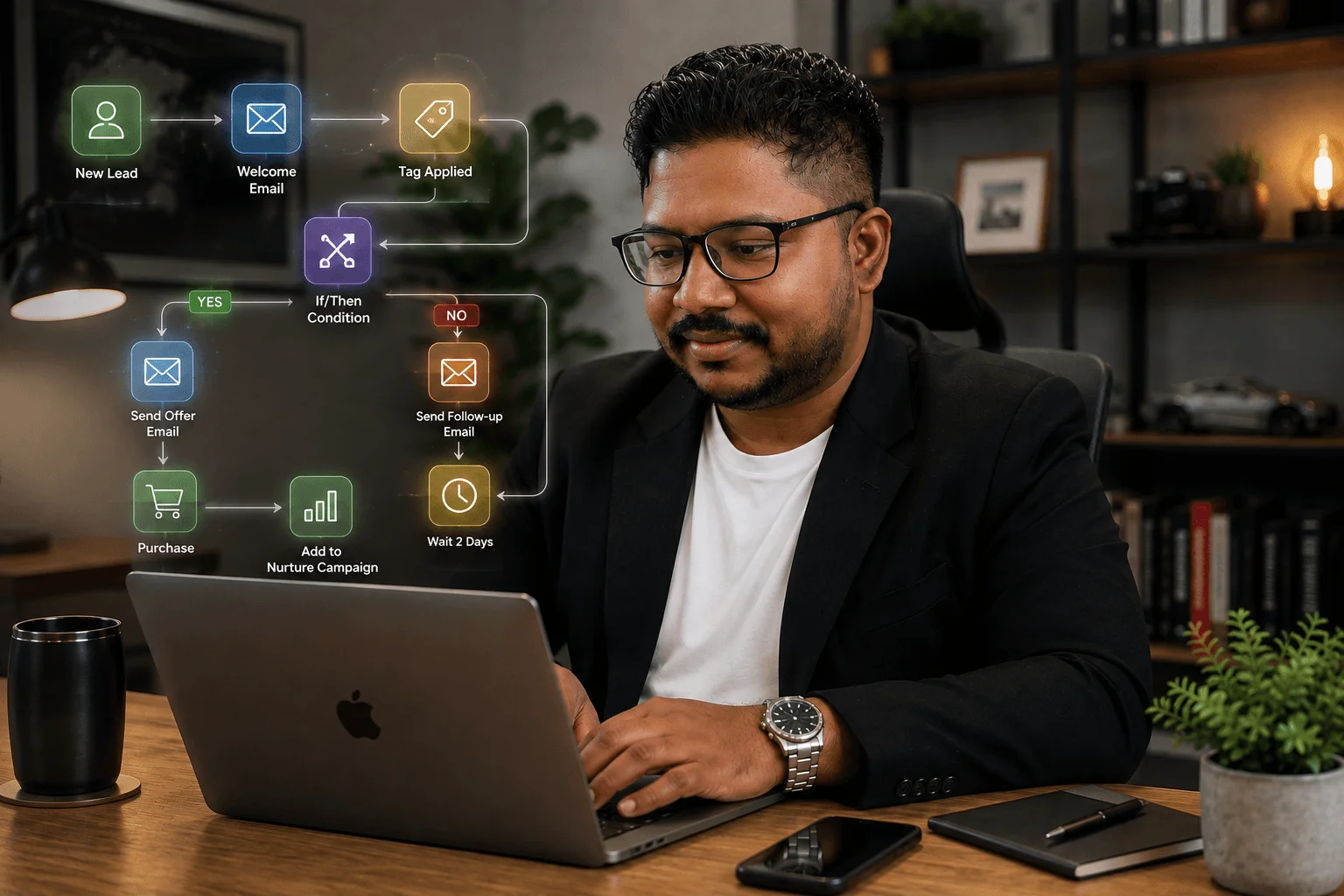
Why is month one the right test?
Because most automation never gets finished.
A tool that pays back in six months is a tool you stop paying attention to in week three.
A tool that returns a sale in the first fortnight gets kept, checked, and improved.
The other reason is cash.
A business with RM30,000 in monthly revenue does not have a "test budget".
It has operating costs and payroll.
So the automations below start with the money already in your pipeline and focus on leads that came in, quotes that went out, and customers who bought once.
They do not create demand.
They stop leaking it.
So, let's get started.
1. An instant first reply to every new enquiry
The faster a business replies, the more likely it is to win the customer, and most businesses reply too late.
The MIT and InsideSales.com lead response study found the odds of qualifying a lead drop 21x when you respond at 30 minutes instead of 5.
A separate Harvard Business Review analysis of 2,241 companies found the average response time was 42 hours.
In Malaysia, the enquiry arrives on WhatsApp.
The automation is simple.
When a new lead messages you, or a web form is submitted, an automatic reply goes out within seconds.
It greets them, thanks them, asks a qualifying question, and says who will follow up and when.
How to set it up
- In the free WhatsApp Business app, turn on greeting messages and set a message for new contacts. One question in the message, for example "Is this for a home or a business?"
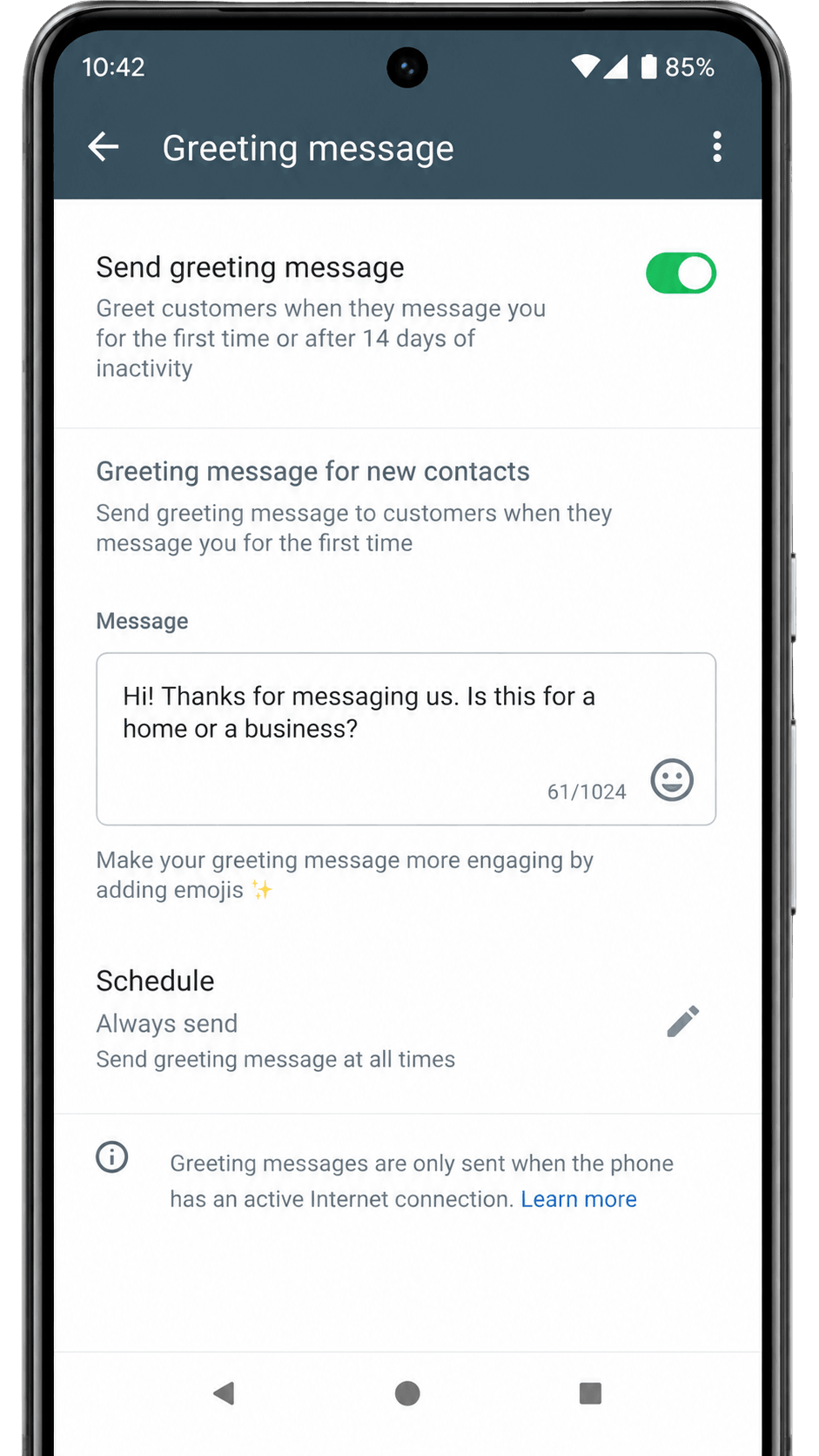
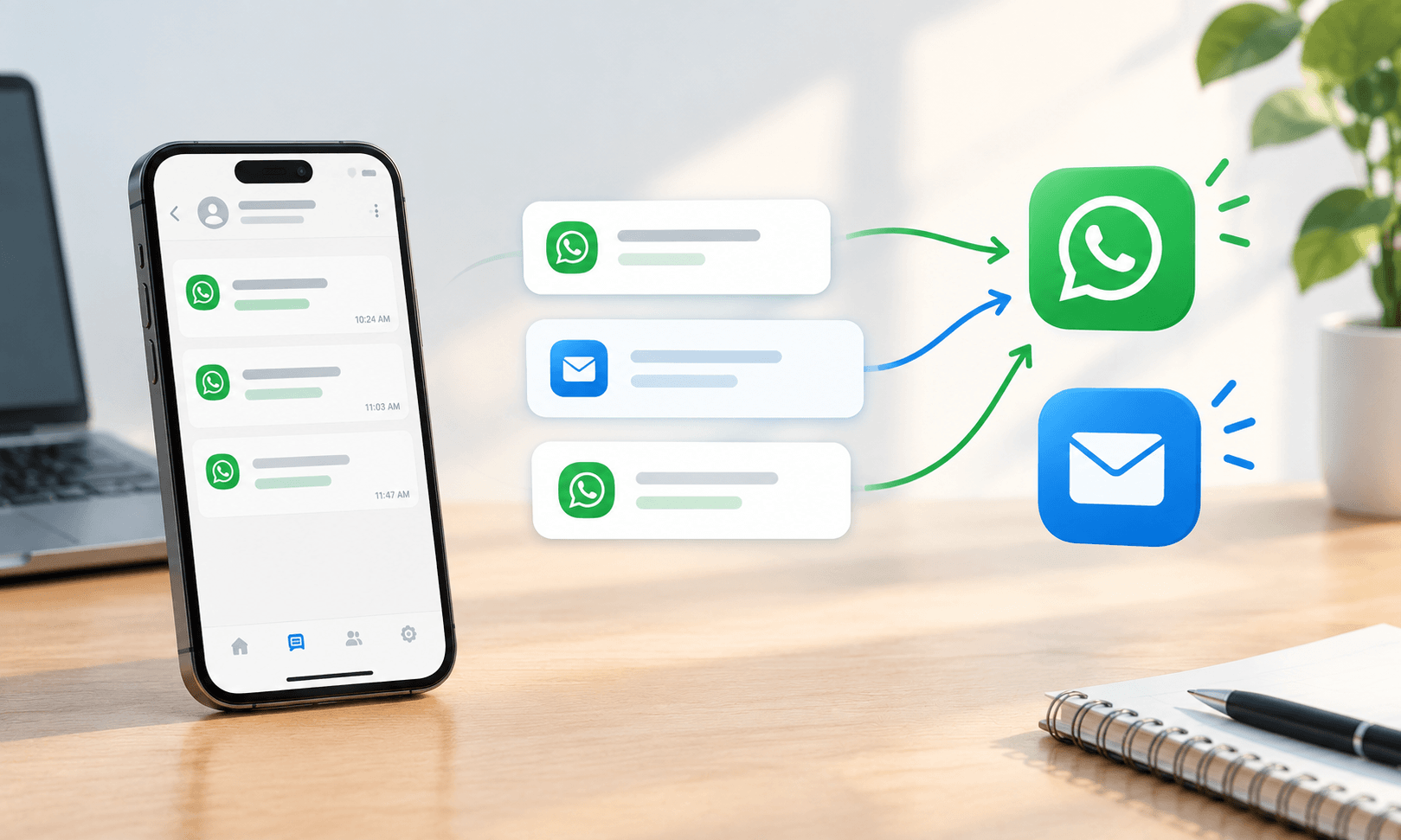
- For web forms, connect the form to a WhatsApp or email auto-reply. Most form tools (Zoho Forms, Tally, Typeform) do this without code.
Zoho Forms: Guide to WhatsApp and Email Notification
Tally: Respondent Email Notifications
Typeform: Send messages or notifications to your respondents or yourself
If you're looking to use Zapier for this automation, you can check out the following guides:
Zapier: Tally+WhatsApp Notifcations, Typeform+WhatsApp Notifications
You can also set up Tally automation using Pabbly: Tally → WhatsApp Cloud API. - Add a second line: "Our customer service team will reply within one hour during business hours (9 a.m. to 6 p.m.)." Then keep that promise.
Cost: Zero cost on the WhatsApp Business app. If you move to the WhatsApp Business Platform through a provider, replies within the 24-hour customer window are free of Meta charges, and the provider's platform fee varies by provider and ranges from RM300 to RM700/month.
Why it pays in month one: if you're getting 20 inquiries a month, and even two of them turn into sales because they got a reply while still interested, the cost is zero, and the return is two sales.
The catch: An auto-reply that promises a human, then goes quiet, damages your lead-nurturing journey. The message buys you an hour, but it turns into a ticking time bomb. It does not replace the follow-up.
2. Ad leads pushed to your phone and CRM, not left inside Meta
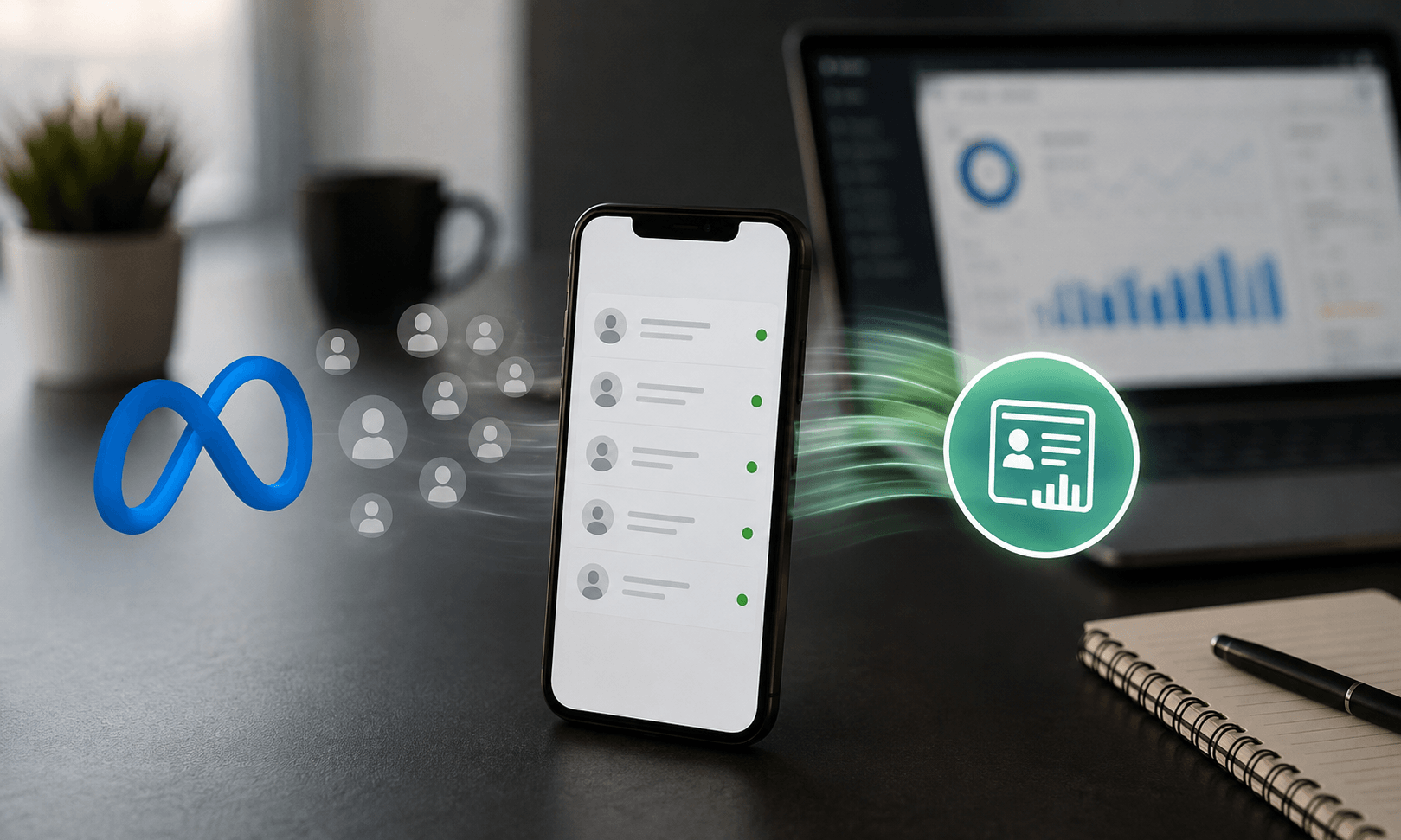
Leads from Meta advertising on Facebook and Instagram sit in Meta's lead center until someone remembers to download them. Several lead-response studies indicate that about 30% of leads are never contacted. This shows that you're not spending just for lead capture but also for leads going idle.
And that's why you need to get those leads into your CRM. whether you're using Zoho, Salesforce, or HubSpot.
This automation moves every new ad lead into your CRM and sends you a notification the moment it lands.
From there, your automation workflow sends the first reply.
How to set it up
- Pick a CRM with a native Meta Lead Ads integration. Bigin by Zoho, HubSpot's free CRM, and Brevo all have one. (Disclosure: I work at Zoho. Judge Bigin by the price and the trial, not by me.)
- Connect the ad account. Map the form fields: name, phone, the qualifying question.
- Set a rule: when a new lead is created, assign a contact an owner and send a WhatsApp or push notification.
Cost: Zero cost on the free tiers of Bigin or HubSpot for one user. Bigin's paid Express plan is about RM28 per user per month on an annual billing plan. And Bigin by Zoho has a feature, Leadchain for Bigin, that will make your lead capture and conversion through social media ads work seamlessly.
Why it pays in month one: this one is measured in leads you already paid for. If you spent RM1,500 a month on lead ads and 30% of leads went cold and untouched, you were wasting RM450 a month before any interaction.
The catch: connecting Meta to a CRM needs admin access to the Business Manager and a verified business. You need to spend like an hour for setup, and expect the phone field to arrive missing the "+60" from time to time.
3. A three-message quote follow-up
A quote without a follow-up is a coin toss.
Most sales teams make 1.3 times as many contact attempts before giving up, according to widely cited lead-response research. Five messages on fixed days, each with one job, is the cheapest sales training you will ever buy.
Why three?
Because the data show the first two follow-ups do most of the work, and the last one does more than the middle one.
Backlinko's study of 12 million outreach emails found one follow-up lifts replies by about 66%. Nutshell's data across 156,000 sequences found that the final "shall I close this?" message gets a 14% response rate, higher than any message after the third. Ignore the "80% of sales need five touches" line you see everywhere.
Nobody can find the original study.
How to set it up
-
When a message or email is marked "sent" in your CRM or spreadsheet, start a sequence or marketing journey.
-
Day 2 (1st follow-up): a WhatsApp or email message asking if the quote arrived and whether anything needs explaining.
-
Day 5 (2nd follow-up): a message answering the most common objection you hear for a renovation firm, which might be the timeline. For a B2B service, it is usually scope.
-
Day 10 (3rd follow-up): a short "Shall I close this query?" message. This one gets the most replies.
Draft the three messages once with your best salesperson. Generative AI tools can assist you in creating the messages based on the inputs (make it as relevant as possible). It should not write the objection answer, because it does not know your objections.
Cost: From RM0 to RM30 a month. Bigin's free tier allows three workflow automations, which is exactly enough for this sequence. Email sequences in MailerLite are free for up to 500 subscribers if you're reaching out to your leads via email.
Why it pays in month one: If you send 20 quotes a month and the sequence rescues one, you will have a positive ROI. Quote values for most Malaysian service businesses range from RM500 to RM50,000.
One closed deal can fund all your automation tools if done right.
The catch: On the WhatsApp Business Platform, a business-initiated follow-up outside the 24-hour window is treated as a template message. Meta bills those in Malaysia at about RM0.35 for the marketing category and about RM0.06 for the utility category (rate card effective April 2026). A follow-up that reads as a promotion gets classified as marketing. Keep it simple and straight to the point. Also, from 1 October 2026, Meta will begin charging for utility templates sent within the 24-hour window, so recheck your bill in November.
4. Appointment reminders, 24 hours and 2 hours before
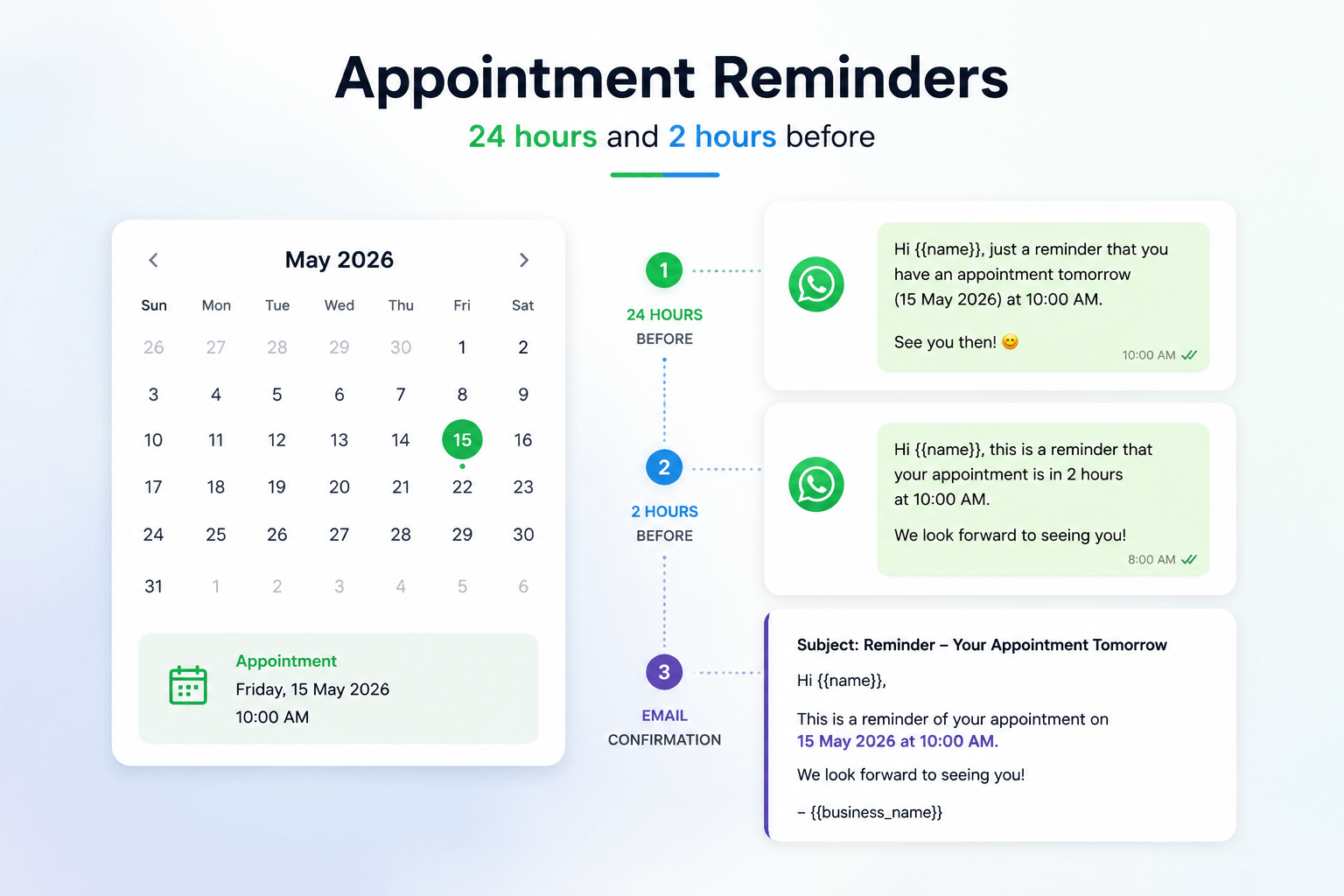
A reminder cuts no-shows by roughly a third.
The study by Koshy, Car and Majeed (2008) found non-attendance fell from 18.1% to 11.2% with SMS reminders. A 2011 systematic review of 29 studies reported an average reduction of 28.9% from automated reminders.
You may wonder why Naven is referencing medical and hospital-related studies. Well, appointment reminders are widely used in healthcare-related industries and can easily be applied to your business appointment scheduling.
If you run a clinic, salon, physio practice, tuition center, workshop, or any business that books time, this is the first automation to switch on.
How to set it up
- Use a booking tool that sends reminders itself. Zoho Bookings, Calendly, and SimplyBook.me all do. Google Calendar appointment schedules send email reminders on the free tier.
- Set two reminders: 24 hours before, and 2 hours before. The second one is where "I forgot" disappears.
- Give the customer a one-tap way to reschedule. A reminder without a reschedule link converts no-shows into last-minute cancellations.
Cost: RM0-RM80 per month for the booking tool. WhatsApp reminders via the Platform are utility messages at about RM0.06 each. A clinic with 300 appointments a month sends 600 reminders for about RM36.
Why it pays in month one: a physio charging RM150 a session with 200 bookings and a 15% no-show rate is losing 30 sessions, or RM4,500, every month. Recovering a third of that is RM1,500 against a RM36 message bill is a good investment.
The catch: the studies are healthcare studies. The direction applies to salons and tuition centers, but the exact percentage is up to you. And a reminder sent as a marketing template costs six times as much as a utility one with WhatsApp Business. Get the category right.
5. A review request one hour after the job
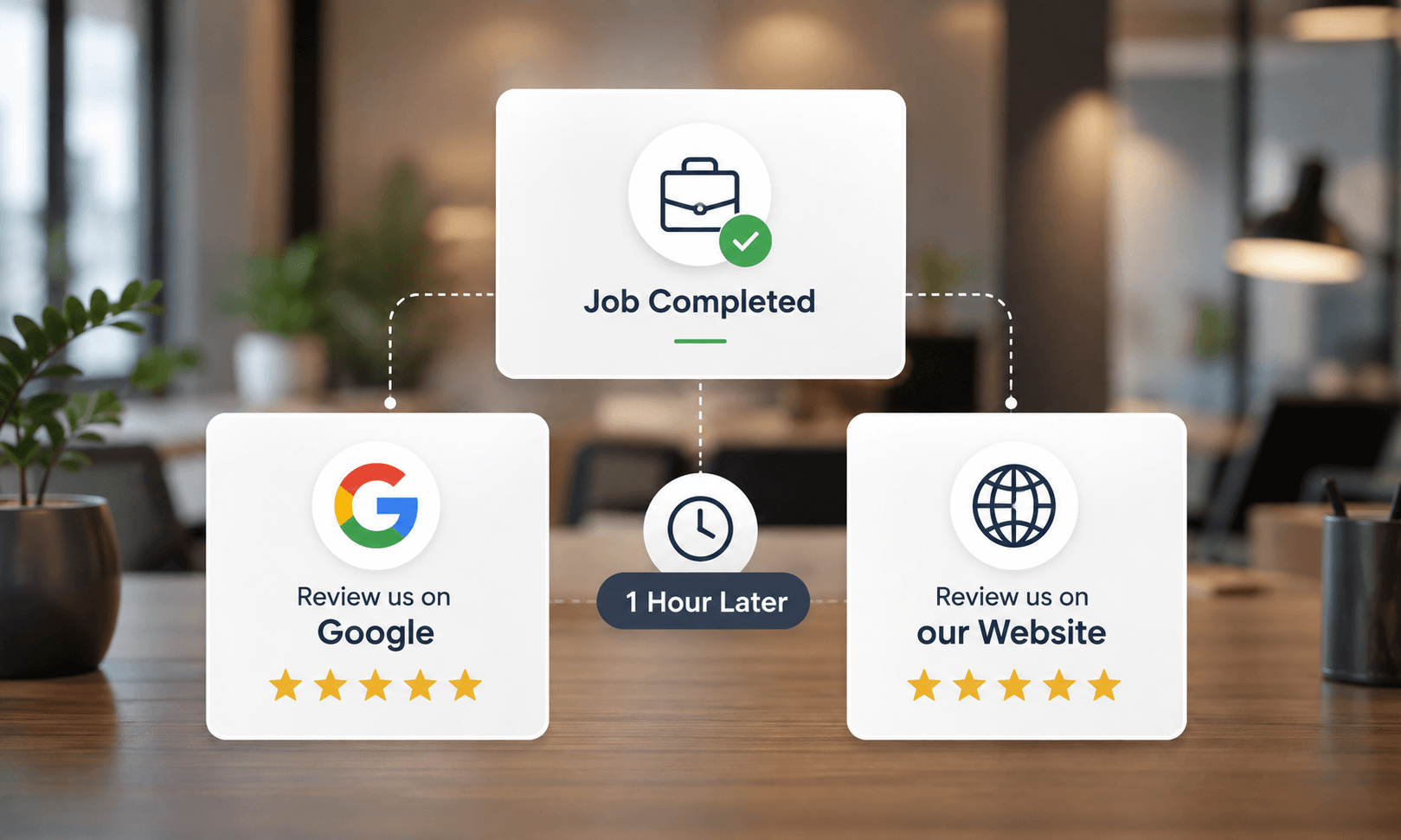
People leave reviews when asked, and almost nobody asks consistently.
BrightLocal's 2026 Local Consumer Review Survey found 83% of consumers who were asked for a review went on to write one. It also found 47% will not use a business with fewer than 20 reviews, and 74% look for reviews from the last 90 days.
That survey was conducted in the US with almost 1,000 people.
I would not assume the same numbers in KL or Penang, but the pattern is the same everywhere.
Recent reviews win over customers who have never met you.
How to set it up
- Get your Google review link. In your Google Business Profile, choose "Ask for reviews" and copy the short link.
- Trigger a message one hour after the job is marked done: the invoice is paid, or the order is delivered. WhatsApp works best in Malaysia. Email is fine for B2B.
- Keep it to two lines. "Thanks for choosing us. If you have 60 seconds, a Google review helps a small business a lot: [link]." No conditions, no discount for a review. Google's policy bans that.
Cost: RM0. The trigger can run from your CRM, your invoicing tool, or a Zapier or Make automation on the free tier.
Why it pays in month one: Reviews compound. Every new review boosts the conversion rate for future local visitors via Google My Business or Google Maps. If your listing goes from 12 reviews to 25 in a month, you have crossed the threshold nearly half of searchers apply before they call.
The catch: You cannot automate the ask to only happy customers. Google treats that as review gating. Send it to everyone and reply to the bad ones publicly within a day.
You can replicate this to gain reviews that you can publish as testimonials on your website as well. It will help you improve your brand authority and credibility within your industry.
6. Abandoned checkout recovery
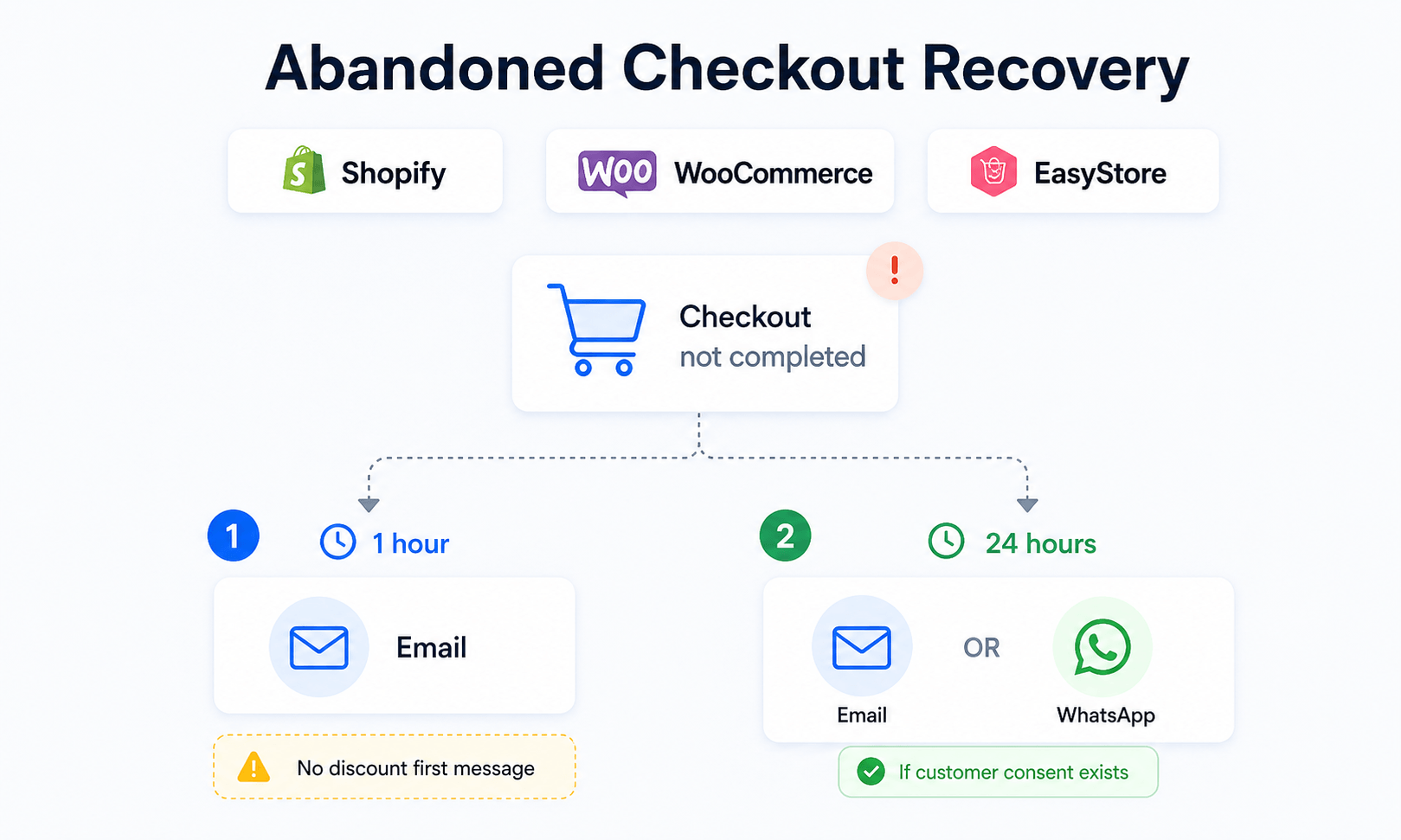
Roughly seven in ten online carts are abandoned.
The Baymard Institute's meta-analysis of 50 studies puts the documented average at 70.2% checkout abandonment.
Klaviyo's platform data across 143,000 flows shows that abandoned-cart emails convert 3.33% of recipients, the highest of any automated flow.
Those are vendor and Western numbers.
Malaysian recovery rates on WhatsApp are not published.
What is published is that abandoned carts are the largest recoverable leak in any online store regardless of country and niche.
How to set it up
- Shopify, WooCommerce, and EasyStore all have built-in abandoned checkout emails. Turn them on. Shopify's is free on every plan.
- Send the first message within one hour. Send a second at 24 hours. Do not send a discount in the first message; you will train customers to abandon on purpose.
- If you have the customer's WhatsApp consent, a second-message reminder on WhatsApp beats email. Keep it to one line and the cart link.
Cost: RM0 on Shopify's built-in emails. RM0 on MailerLite up to 500 subscribers. WhatsApp reminders are marketing-category templates at about RM0.35 each.
Why it pays in month one: a store with 300 abandoned carts a month at a RM120 average order recovers about 10 orders at a 3.3% conversion rate. That is RM1,200 for a bill under RM50.
The catch: This only works if checkout itself is not the problem. If your shipping cost appears only at the last step, fix that first. Baymard estimates checkout design alone can lift conversion by around 35%. No email fixes a bad checkout.
7. A win-back message to customers who have gone quiet
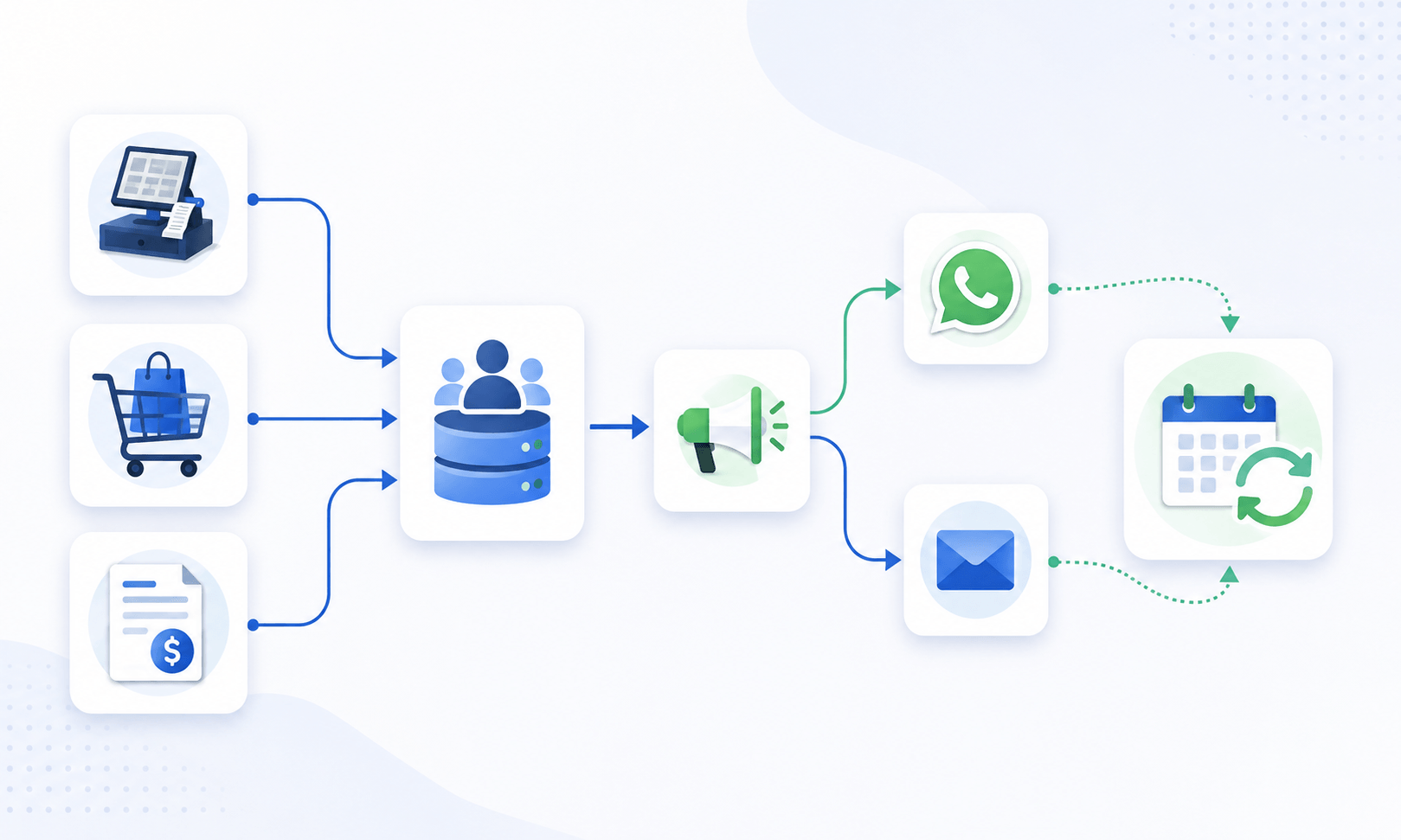
Your cheapest new customer is an old one.
A win-back message is sent to anyone who previously bought and has not bought within a set period, typically 60 or 90 days.
It is one message, not a sequence.
How to set it up
- Pull a list from your POS, Shopify, or invoicing tool: customers whose last purchase is more than 60 days (retail, F&B, beauty) or 90 days (services, B2B) old.
- Send one WhatsApp or email message: Name what they bought. Ask one question, or offer one specific thing. "Your last service was in May. Time for the next one? Reply "YES," and we will book you."
- Set it to repeat monthly, so each customer gets the message once when they cross the threshold.
Cost: For 200 customers a month on WhatsApp marketing templates, about RM70 in Meta fees. On email, RM0 to RM40.
Why it pays in month one: A cafe with 500 lapsed customers and a RM25 average spend needs 8 people to return to cover RM70 in messages. A car workshop with an average service cost of RM400 needs one.
The catch: A broadcast to people who did not opt in gets your number reported, and Meta rate-limits or bans WhatsApp Business accounts with high block rates. Only message customers who gave you their number in a transaction, and give them a one-word way to opt out.
How to know whether your automation actually paid
Write down three numbers on day one and again on day 30.
- Enquiries received.
- Enquiries that got a first reply within an hour.
- Sales closed from those enquiries.
- For the reminder and review automations, add no-show rate and Google review count.
If a number did not move, the automation is not the problem. The message is.
Change one line and run another month.
Do not measure "time saved".
It is real, but nobody believes it, including you. Measure sales, no-shows, and reviews.
FAQ
Which marketing automation should a small business set up first? The instant first reply to enquiries. It costs nothing in the WhatsApp Business app, takes 10 minutes, and addresses the biggest leak: slow response. Lead response research shows qualification odds fall by a factor of 21 between a 5-minute and a 30-minute reply. Add the quote follow-up sequence second.
How much does the WhatsApp Business API cost in Malaysia in 2026? Meta charges per template message in ringgit. Marketing messages are about RM0.35 and utility messages about RM0.06 each (rate card effective April 2026). Replies within 24 hours of a customer's message are free. Your provider adds a platform fee, usually starting at RM150 per month. From 1 October 2026, utility templates within the 24-hour window will also be charged.
Do automated messages reduce no-shows for non-medical businesses? The strongest evidence is from healthcare, where SMS reminders cut no-shows by roughly 28% to 38% across multiple studies. Salons, tuition centers, and workshops report the same direction. The exact figure depends on your customers, so measure your no-show rate for a month before and after.
Can I automate Google review requests? Yes, as long as you ask every customer and offer nothing in return. Google's policy prohibits paying for reviews and prohibits sending requests only to customers you expect to be positive. Trigger the request 1 hour after the job is done using the direct review link from your Google Business Profile.
Is marketing automation worth it for a business with under RM50,000 monthly revenue? Yes, if you start with automations that act on demand you already have: enquiries, quotes, bookings and past customers. All seven here cost between RM0 and RM200 a month at small-business volume. Avoid platforms priced from RM800 a month until you have outgrown the free tiers.
What is the biggest mistake with marketing automation? Sending marketing-category WhatsApp messages when a utility message would do, and promising a human reply that never comes. The first multiplies your bill by six. The second turns an auto-reply into a reason to choose a competitor.
Start with the one you can finish this week
Pick automation 1 today.
It is free and takes ten minutes. Add the quote follow-up when you send the next quote, and the review request when you close a job.
By the end of the month, you will have three running, a cost under RM50, and a number to compare against.
Suppose you want the full setup for the first-reply and follow-up systems, including the message templates, the WhatsApp first-reply workflow, and the quote follow-up workflow, the pages on Businessai. my will walk you through step by step.