What is GEO? Generative Engine Optimization Explained
GEO explained in plain language. You will learn what generative engine optimization is, how AI answers pick their sources, the 30–40% study, GEO vs SEO and more
I've started experimenting with AI visibility strategies with GEO.
So, I thought it would be better for me to define this term properly in the Malaysian context. Jargon merchants own hundreds of definitions. I have my own way of defining this term.
Here is what GEO actually is, whether it works, and what to do about it, in a simple way that you can understand.
Start with the moment that makes it real.
A customer in Klang opens ChatGPT and types, "best aircond services near me, find the most reliable one for me". ChatGPT came up with the top 5 aircond servicing companies near Klang, including their names, ratings, short descriptions, and contact numbers.
It also recommends the top pick. When you click on each company, a sidebar appears with individual company results, similar to the local results you see on Google. In addition, it also includes:
- What people say
- Services (in some companies)
- What it's like
- Good to know
Your business is either in that answer or it isn't.
There is no page two or position seven. The AI picked five companies that a potential customer will probably read about, then call or WhatsApp them.
GEO is the work of being in that answer.
That's the whole idea. And everything else is just details.
How AI answers choose who to mention
There's no special method.
Generative AI tools build their answers based on two mechanisms:
- What they learned during training
- What they read on the live web when the question is asked
When they recommend businesses or state researched facts, they learn from sources they can easily read and trust. It means the sources need to be clear websites, consistent directories, reviews, news mentions, and pages that answer questions directly.
Maybe you may wonder why the machine's selection process rewards the boring work, like a page that states facts plainly and a business that's described the same way everywhere on the Internet.
Does this sound familiar to you?
Yes. This is what Google has rewarded for years, and that's the main secret of GEO. Most of the strategies involved are just SEO methods with a new name tag.
One job, four different terms
You'll see different services being offered since AI search has become part of the digital marketing discipline. But they actually overlap completely.
- GEO (generative engine optimization). The most common name, from the 2023 study that started it.
- AEO (answer engine optimization). Same as GEO, named after the destination instead of the process.
- LLMO or AI SEO. The variations that you will see from service providers and proposals—still the same as GEO.
If someone tries to sell you GEO and AEO as two separate services with two prices, hold it right there.
It's one discipline, as I've mentioned earlier. Your focus should be on making your business easy for AI systems to find, understand, and present to people searching for your products and services.
GEO vs SEO: same foundations, different scoreboard
Let me give you my honest comparison of the two without a table.
SEO wins a click. You rank for search terms related to your products and services; customers click search results and land on your site. The scoreboard here is positions and traffic.
GEO wins a mention. The generative AI tool provides answers that mention your brand as a source or recommendation for your customer's question.
An analysis conducted by Contentful shows that visits from AI search are at only 10% compared to traditional search via search engines. But it also shows that fewer visitors from AI search convert, but they convert better due to their pre-qualification. In other words, people are actually asking higher-intent questions with generative AI tools than simply browsing.
Both things work well.
Higher traffic for increased brand visibility.
Less traffic for increased conversion.
But you may want to consider what matters most to your budget.
You need to know that the work for both SEO and GEO overlaps far more than it differs. The fundamentals remain the same.
You need a clean, fast, reliable site with clear answers that include consistent business details and real industry authority to serve both GEO and SEO.
As I'm working on analysis for my own project, Kerja Remote, I found that a site that's good for AI answers is also good for SEO. It's either strong in both or weak in both.
Does GEO actually work? The evidence
GEO is still new but growing.
I'll give you the strongest evidence that I've found from my in-depth research.
The founding study that I've quoted earlier, the 2023 academic paper that came up with the GEO term, tested across 10,000 real queries. The study found that adding quotes, statistics, and citations to a page increased its visibility in AI answers by 40%.
Not keywords.
Not the number of word counts.
The machine needs specific data to quote and verify.
That matches what I see in my audit work with Kerja Remote. The website appears among the results for people searching for remote jobs in Malaysia. For example, if you search for " where to find remote jobs in Malaysia," you will find the following result on ChatGPT.
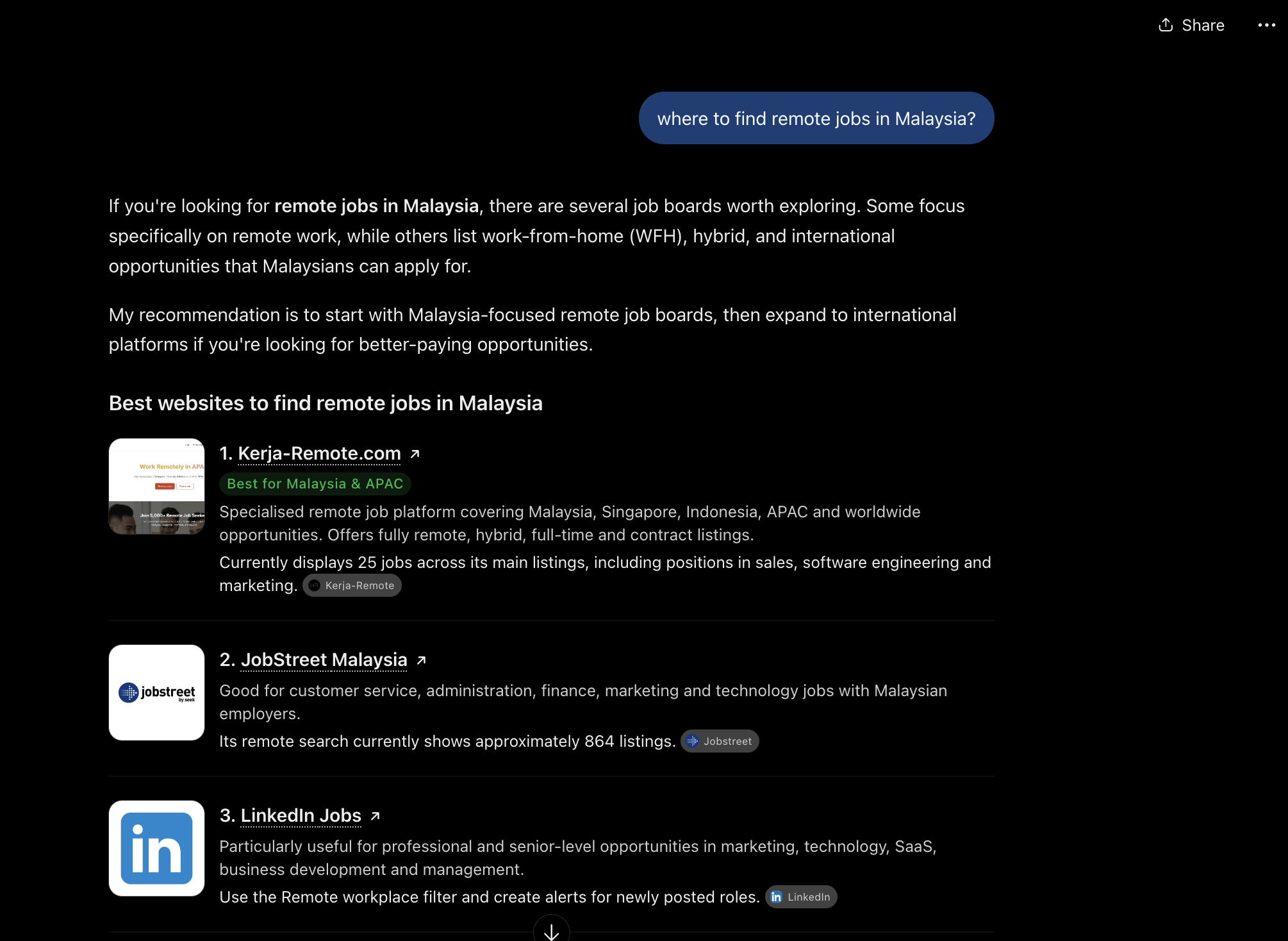
As you can see, ChatGPT has also mentioned that the site is "Best for Malaysia & APAC".
When I used Gemini and asked the same question, this was the result.
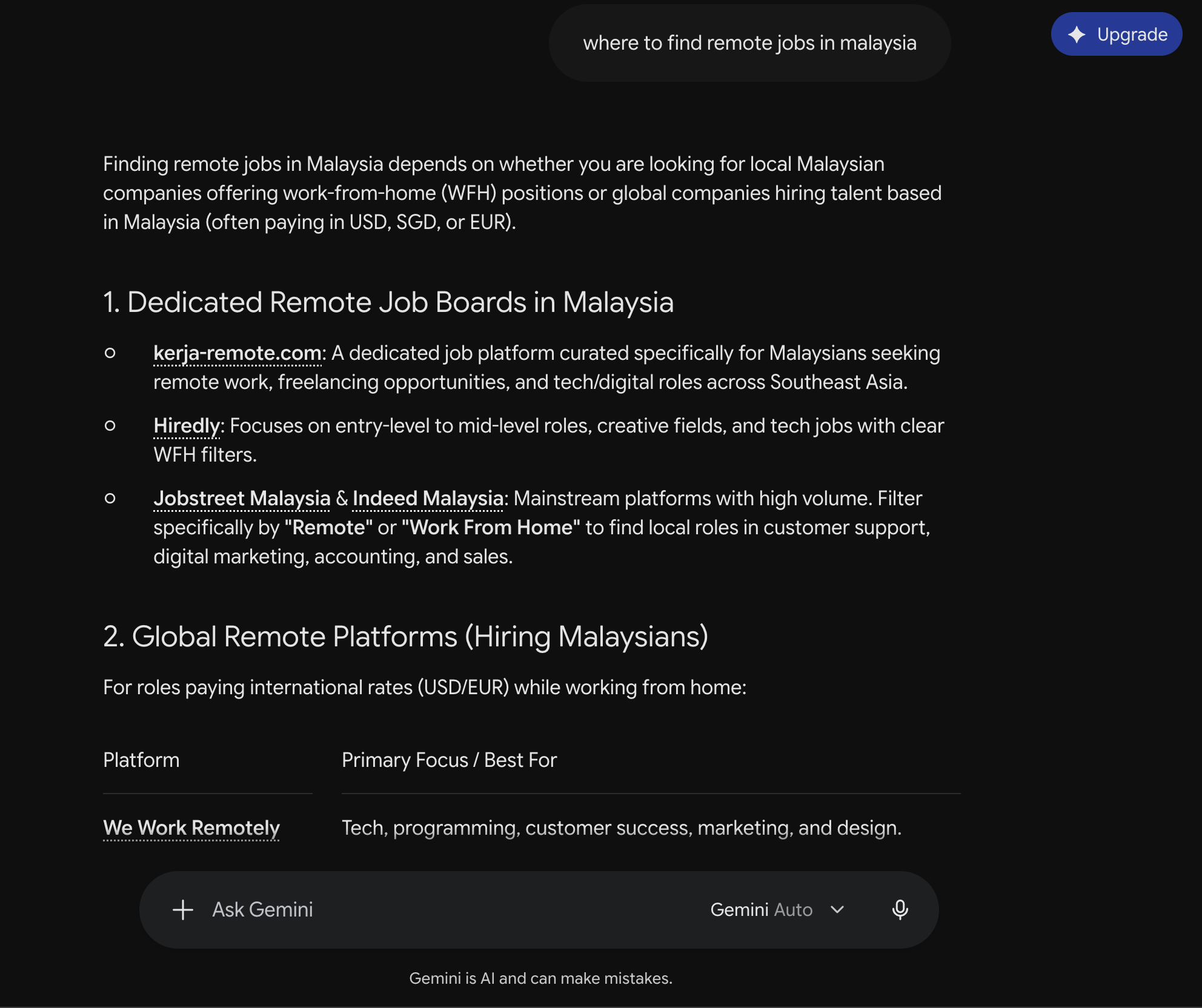
We can still see that Kerja Remote is being mentioned. But when I asked the same question on Perplexity and Claude, Kerja Remote was not mentioned in any of the answers.
Most probably, Kerja Remote is not as authoritative as other job sites that have been created for more than a decade.
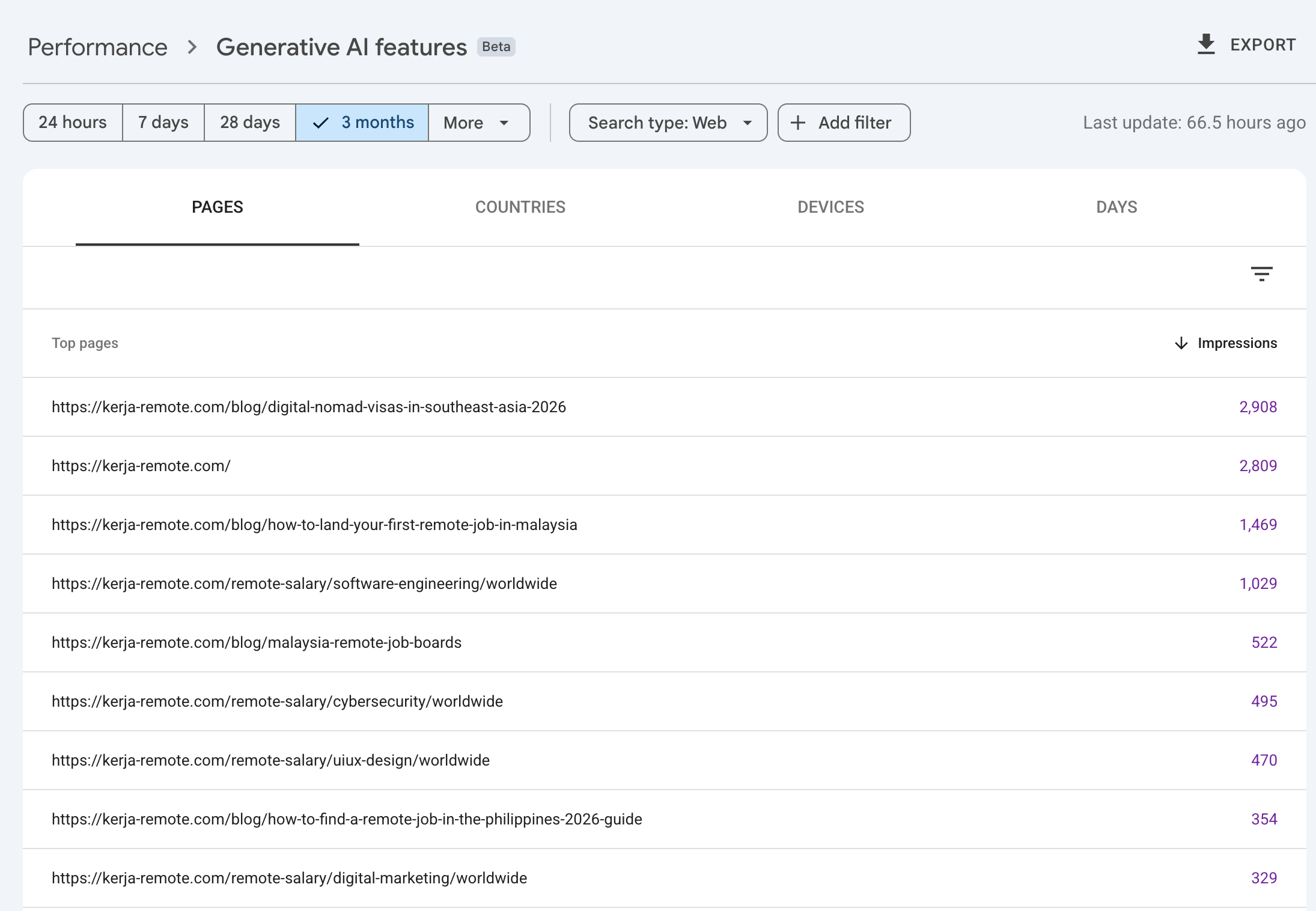
I also checked the website's Generative AI performance in Google Search Console. We can see that Kerja Remote has been getting good impressions from Generative AI performance over the past 3 months.
Apart from my own findings, Signal AI reports that 80-90% of AI answers draw on earned coverage—press, reviews, and mentions on other sites. That's their measurement of how often those sources show up, not a ranking formula.
But the practical reading is hard to avoid: the more credible places mention you, the better your odds of being cited. And since most of your competitors have almost no earned coverage, every mention you collect is an edge they don't have.
What others say about you feeds the AI generative tools as much as you say about yourself. That's why directory listings, reviews, and mentions matter the most for GEO.
So is SEO dead?
No, and anyone telling you otherwise is trying to sell you something else.
Search engines like Google still handle billions of searches per day. It still has the biggest magnitude of online traffic compared to any other online traffic source. As you already know, half of those searches now show an AI Overview, which means Google itself has become a part of an answer engine.
The famous example of this is HubSpot. Their blog reportedly lost around 81% of its traffic as AI answers absorbed the generic questions it was primarily built to answer.
This lesson isn't about "SEO died". It's that the generic content died, and content worth citing inherited the traffic.
The real question here is not about SEO or GEO. It's whether your web pages are optimized for both systems.
What GEO looks like in practice
These are six things you can do as a business owner to get started with GEO.
- Answer real questions in complete sentences, with a number or date inside. " A full home physio session in Klang runs 60 to 90 minutes" is citable. "We offer quality sessions" will be invisible.
- Add FAQ sections to key pages. Write it in the way customers actually ask, including features and pricing questions.
- Put a named human on the site. Generative AI tools like ChatGPT favor sources with an identifiable person behind them.
- Use statistics, quotes, and valuable sources. Early GEO studies support this part. Cite where the facts and numbers come from naturally within your content.
- Keep your business details identical everywhere. Similar to the Local SEO method, make sure your business details are consistent across the site, Google My Business page, directories, and Facebook. Inconsistency will lower the credibility and trust of your business.
- Ask the AI. Open ChatGPT as the "best [your service] in [your town]" and "what do you know about [your business]?" Try searching them in incognito mode with a new account, if possible, because sometimes using your own account can show you biased answers based on your search history.
GEO from the Malaysian angle
Every major GEO article is written for the global market and specifically for the American market.
Two things change for the Malaysian market
First, the language.
Malaysians ask questions in both English and Bahasa Malaysia, and the answers come from various sources. A business with pages in the language its audience is actually looking for has an edge that no global guides on GEO can offer.
There are no global guides on GEO that know "servis aircond" exists.
Second, low competition.
Most Malaysian SME websites still fail the basics.
- No FAQs
- No named human
- Vague claims
- Inconsistent listing
When a Generative AI looks for a citable local source and finds almost one, the business that followed the six GEO optimization tasks that I've shared above wins by default.
If you realize it, in the US, GEO is a war. In Malaysia, in most industries, it's an open field for another year or two.
My honest warnings
You need to be aware of these three things.
Measuring GEO performance is still in its early stages. There is no accurate GEO rank tracker everyone agrees on yet.
Tools exist. I've reviewed Otterly.ai, which monitors AI mentions from about RM125 per month. But you still need to do manual checks from a Malaysian context before trusting its numbers.
Nobody can guarantee citations. It works the same way as no one can guarantee you rankings for specific keywords on search results pages. AI answers vary widely across tools, over time, and even between identical questions. Anyone promising "we'll get you into ChatGPT's answers in 30 days" deserves the same red flag as the old "page one guaranteed".
Consistent implementation raises your odds.
But nothing buys certainty.
GEO service should match its maturity. On average, the AI-visibility audit in Malaysia costs between RM2,000 and RM5,000 as a one-off engagement.
And I don't believe in an AI-only visibility audit, because you need to conduct a comprehensive audit of your website to identify all issues and fix them to make your assets GEO-ready.
If a service provider is offering you a GEO retainer priced like enterprise software at this early stage, it's certainly a red flag.
What you should do right away
Don't buy anything yet.
Run a free AI audit for your website.
Ask ChatGPT and Google about your business and category. Write down the results. Then work through the AI search layer of the checklist, starting with the six moves that I've covered earlier.
It should take just an evening.
Ask the same questions in three months.
What will make the difference in the next three months?
Publish something citable.
Check what the AI generative tools say. If you're missing something on your landing page, blog post, or playbook, adjust them accordingly.
The name might keep changing, but not the fundamentals.
You may also want to evaluate and analyze your competitors who are cited or mentioned as sources for questions related to your business. Competitor analysis still plays a huge role in GEO as well.
FAQ
What does GEO stand for in marketing?
GEO stands for Generative Engine Optimization. It's an optimization strategy for getting a brand or business mentioned and cited in AI-generated answers by tools like ChatGPT, Gemini, Claude, Google AI Overviews, and Perplexity. The term comes from a 2023 academic study. There are other terms such as AEO (Answer engine optimization), LLMO (Large Language Model Optimization), and AI SEO. They are identical to GEO.
What is the difference between GEO and SEO?
SEO aims to rank pages so they are clicked from the search results pages of Google and other search engines. GEO aims to make your brand or business one of the sources AI tools cite when answering questions about you. The foundation of both overlaps heavily. Clear content, consistent business details, and relevant authority are factors that work for both. But positions and traffic matter to SEO; mentions and citations matter to GEO.
Does GEO really work?
The strongest evidence is the 2023 study that introduced the term "GEO". The study, based on roughly 10,000 queries, found that pages with statistics, quotes, and cited sources were 30% to 40% more visible in AI answers. GEO helps you increase your odds of being cited, but there's no guarantee of a specific mention.
Is SEO dead now that AI answers exist?
No. Google still handles vastly more searches than any Generative AI tool, and over half of them are now included in AI Overview. So, one set of well-built pages serves both GEO and SEO. What's actually dying is generic content that answers questions AI can now answer itself. Specific, experience-based, citable content gains the traction it deserves.
How much does GEO cost in Malaysia?
AI-visibility (GEO) audits in Malaysia run from RM2,000 to RM5,000 as a one-off engagement in 2026. But it is not limited to an AI-visibility audit; a complete marketing audit is required to make the web pages citation-worthy. And most SEO retainers offered by Malaysian providers now include GEO work as well. The fundamentals remain the same: you need FAQ sections, plain-language answers, and consistent listing details that cost nothing but time. Be wary of anyone guaranteeing AI citations at any price.
Can I do GEO myself?
Yes. The basics. Answer your customer questions in simple sentences with supporting statistics, quotes, and citations. Make sure to add FAQs, name a real person on your site, keep business details identical everywhere, and ask ChatGPT about your business every quarter to track the progress. Paid help will make sense for audits and monitoring once the fundamentals are in place.