GEO Checklist for Businesses in Malaysia: 25 Steps (2026)
A free 25-step GEO checklist for Malaysian businesses. Check what Gen AI tools say about you, and improve the odds of increasing AI visibility the right way.
Are you new to the term GEO?
I'm sure you've heard of it, but you're yet to fully focus on optimizing your brand and business for generative engines.
You can start with this guide here: What is GEO?
It's a simple guide that will help you have a clear understanding of GEO before putting this checklist into action.
I assume the basics of your website are in order. If you're not sure, my 40-step SEO checklist should be your first step, because AI systems read the same clean, fast, consistent site that search engines reward.
My honest note before you get started.
GEO is new.
Nobody can guarantee you will be cited or mentioned in AI answers.
These checklists improve your odds by outlining a few practical actions. Starting with a 2023 study that found pages with statistics, quotes, and cited sources increase the odds of visibility in AI answers by 30% to 40%.
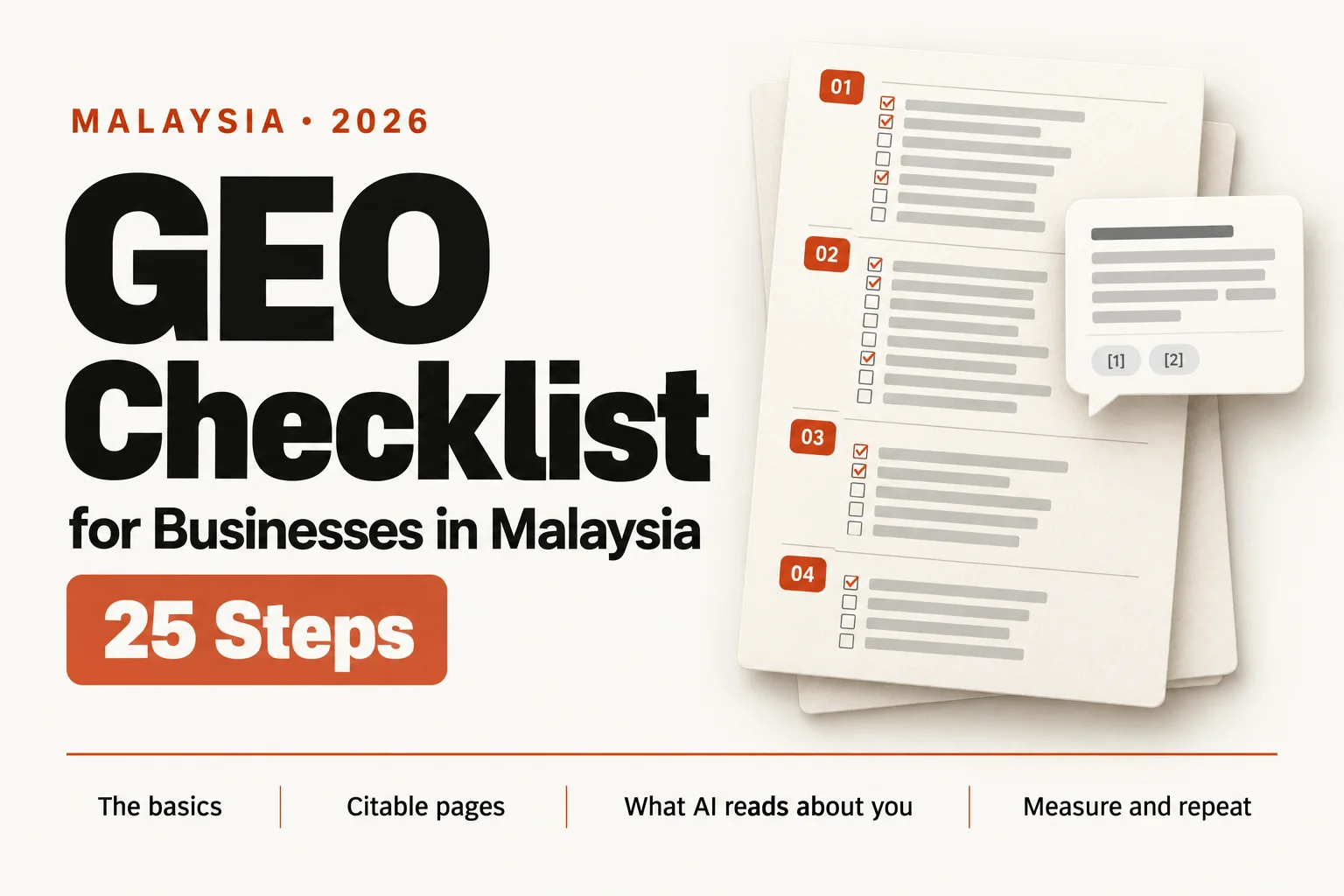
The GEO Checklist at a Glance
Checklist 1-7 (The basics): Ask the AI tools about your brand and category, repeat them in Bahasa Malaysia, check AI crawlers' accessibility, and complete the Google Business profile.
Timeline: Completed within a day.
Checklist 8-16 (Citable pages): Plain-language answers that even a layperson can understand, an FAQ section on the pages that matter, numbers with dates, statistics with sources, named quotes, a named representative of your brand or business, schema markups, focus on one topic per page, and visible update dates.
Timeline: Completed in one week.
Checklist 17-21 (What AI reads about you): Join the sources AI already cites, grow and answer reviews of your brand, focus on earning one mention a month, publish one experience post a month, keep descriptions identical across platforms.
Timeline: One month and ongoing.
Checklist 22-25 (Measure and repeat): Quarterly AI answers re-check, track cited sources, watch branded search, add a monitoring tool only when basics are done.
Timeline: 3 months and ongoing.
GEO Checklist 1-7 (Basics)
GEO starts with measurement.
You need to find out what AI machines currently believe.
1. Ask AI About Your Business
- Open ChatGPT (the free tier is fine). Ask this question: "What do you know about [your brand/business name] in [your location]?" As an example, we will do the following prompt: "What do you know about Naven Pillai in Malaysia?"
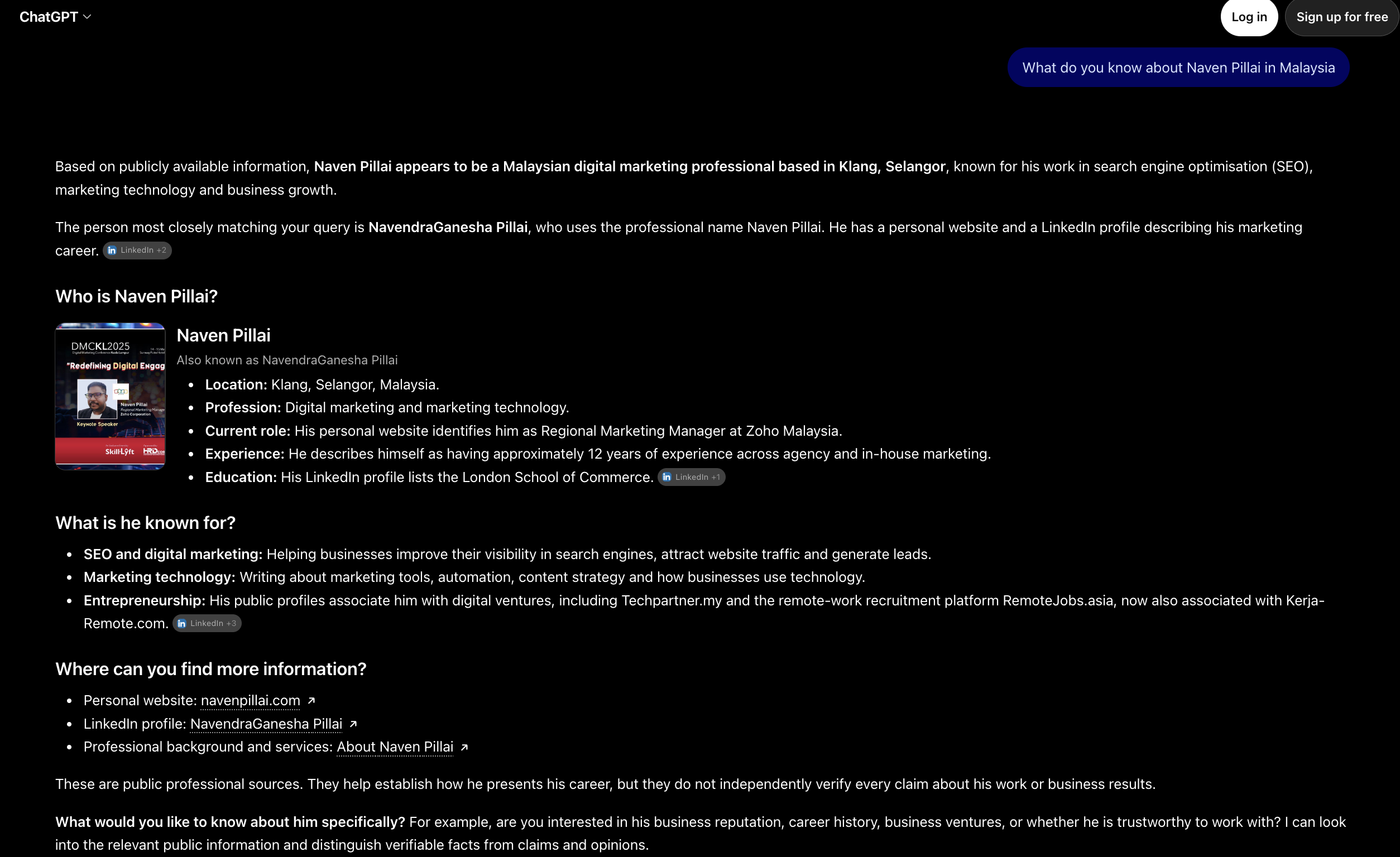
- Save the full answer in a doc with today's date. This is your baseline.
- Note what's wrong or missing. Outdated products or service descriptions, wrong locations, or you get the following result: "I don't have information about this business." The empty answer is what the rest of this checklist will help you resolve. But if your brand or business has been online for a considerable amount of time and your pages are indexed in search results, you're unlikely to get a blank answer from AI tools.
2. Ask About Your Category
- Ask the questions your potential customers or someone searching for your products or services: "best [your service] in [your town]", "recommend a [your trade] near [area]", "how much does [your service] cost in Malaysia"
- Run the same questions on other Generative AI tools like Claude, Perplexity, Google (where AI overviews appear)
- Record three things each time: whether you are mentioned, which competitors are cited, and which websites are cited as sources. The cited sites matter the most. As you will be using them later, make sure to copy and paste those sites in a doc.
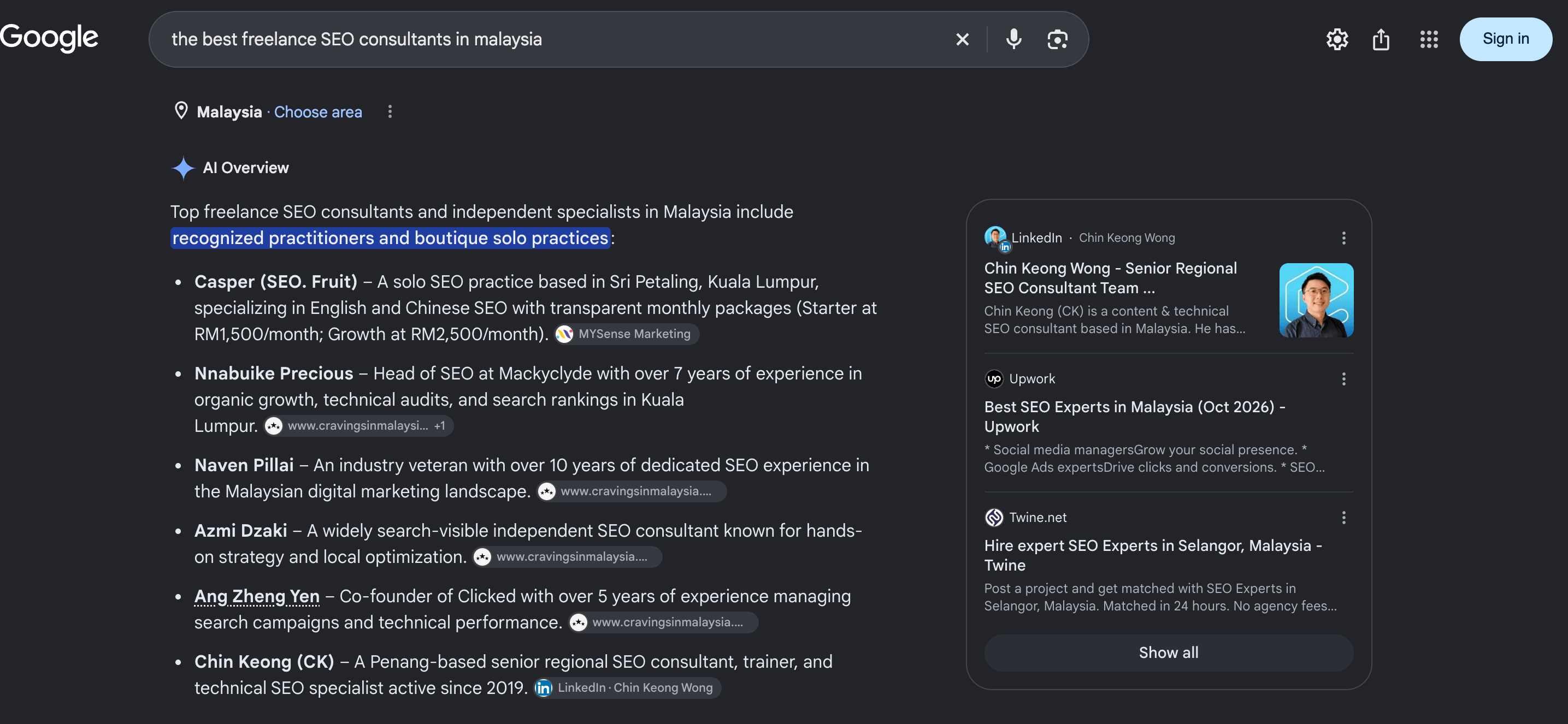
- As an example, I will ask the following question about my personal brand on Google, and let's check what the AI overview shows: "Best Freelance SEO consultant in Malaysia." Check the result in the screenshot below.
3. Repeat in Bahasa Malaysia
- Ask the same questions as a Malay-speaking customer would. Something like "servis aircond terbaik di Klang".
- Record the answers separately. English and Bahasa Malaysia answers are more likely to be cited by different sources. My recent experiments indicate the Bahasa Malaysia answers are easier to optimize for AI answers and are often overlooked.
- Note which language your ideal customers use. That decides your efforts and the type of content you need to produce to stay relevant.
4. Check you're not blocking AI crawlers
- Check yoursite.com/robots.txt in your browser.
- Look for Disallow rules attached to AI bot names like GPTBot, ClaudeBot, or PerplexityBot. If you're using a CMS like WordPress, security plugins may block these by default without asking you. If you're using a CDN like Cloudflare, you need to check the settings as well.
- Blocking them is a legitimate choice for publishers. But for brands and local businesses, you don't want to self-sabotage your online marketing efforts. If you find your AI bots are blocked, remove them by manually editing your robots.txt file. txt file, or make the changes to your SEO plugin settings or hosting settings.
Disclaimer: Please be mindful if you're hosting sensitive information on your site. If that information is not publicly available, block AI bots on the specific pages you should already be blocking from appearing in search results.
5. Check your pages as Text
- Open your most important pages. Right-click and choose "view page source," and search for a sentence you know is on that page.
- If your content appears in the source, AI crawlers can read you. If the source is mostly code and your Text is not visible, it will be difficult for AI bots to crawl and understand your content. You may want to talk with your developer.
- You can do a simpler second check using any free "website text extractor" tool and see the result. What comes out is what an AI system sees.
6. Complete your Google Business Profile
This part is covered step by step in the SEO checklist. In terms of GEO relevance, AI tools that answer "near me" questions rely heavily on business profiles and their reviews.
An empty business profile is an empty entry to a citable source. Every field filled, ten real photos, and an accurate category of your business.
7. Make your business details identical everywhere
- Write your canonical format once and use it everywhere; exact business name, address, and phone number. It's the same NAP (Name, address, phone number) used in local SEO.
- Search for your business name and phone in quotes on Google. List every directory and site where you appear.
- Fix every mismatch. For generative AI tools recommending your business, misspellings and two to three different phone numbers look like multiple businesses rather than one. Consistency is trust, and trust is citation.
GEO Checklist 8-16 (Citable Pages)
This is where you start your writing work.
Everything here follows one specific rule from the research: AI tools quote what is specific, attributed, and easy to lift.
8. Write plain-sentence answers to your top five questions
- Research and come up with the top five questions your potential customers ask most about your products ot services. Check your support tickets, WhatsApp history, and knowledge base (if you have one).
- Answer each question in just two to three sentences that would make sense. Read them aloud and check whether they make sense and offer a direct answer. For example, "A home-based physiotherapy session in Klang that runs 60 to 90 minutes per session costs RM150 to RM250 in 2026"
- Place each answer as a summary or a short answer at the top of relevant pages. That answer shapes the subject, fact, number, and year that AI answers emphasize.
9. Add FAQ sections to key pages
- Group your customer questions by pages. For instance, pricing questions on products or services pages, trust questions on the about page.
- Add four to six Q&As per page. Phrase them in a conversational style, as customers would ask, and answer in two or three sentences.
- Answer the price questions honestly. Very few Malaysian business owners are transparent about their pricing. I understand that businesses in some industries do not publicly disclose their pricing on their websites to remain competitive. But if you want to be cited and mentioned in AI answers, you need to find a way to answer your potential customers' pricing questions.
- If you're using CMS platforms like WordPress or Webflow, use an SEO plugin's FAQ block. For FAQ schema, plain text and text FAQ still work without any plugins. You can check how I've added the FAQ section in some of my pillar articles.
10. Put numbers and dates to your claims.
- Audit your pages for vague claims. Don't simply use something like " years of experience", "affordable", "many happy customers".
- Replace each of them with real values: "since 2010" or "12 years of experience", RM150 to RM250 per session", "over 500 customers served".
- Date anything that changes, especially pricing. If you're introducing new pricing for your products or services, you may add a small note that the pricing was updated. A dated fact is more likely to be quoted and signals to generative AI tools that you're credible and trustworthy.
11. Add statistics with credible sources
The single strategy is to cite a study behind your claims. Even the early studies of GEO have repetitively mentioned cited statistics that raised AI visibility by 30% to 40%.
- Find two or three real statistics relevant to your niche. It can be from a government source, industry research, or from your own data.
- State where the source originated from. For example, " The latest data from the Department of Statistics Malaysia (DOSM) and reports involving the Malaysia Communication and Multimedia Commission (MCMC), smartphone usage among individuals in Malaysia has reached 99.6%."
- Your own operational stats matter too. The best part of it is that others can't copy them. For instance, "In 2025, we have resolved 1980 support tickets with 4.85 ratings."
12. Add quotes with names attached
Quotes were the second tactic that the study found effective.
- Add one or two named, dated customer testimonials on your primary products or services pages. You don't have to put all the testimonials here; choose the ones that can amplify your authority. If you've worked with a renowned brand in Malaysia, get their consent and publish their testimonials.
- If you have any relevant certification, you can list yourself as an author for the content you produce. A named claim beats an anonymous one. For example, you may have the Ts salutation, which means "Technologist" or "Professional Technologist". It recognizes individuals with specialized academic qualifications, practical experience, and competence across recognized technical and technological fields (such as IT, engineering tech, and manufacturing). Use something that will complement your products or services.
13. Put a named human on the site
- An about page that includes your real name, picture, years of experience, and credentials with dates can help improve the credibility and trust of your website in the eyes of search engines and AI answer tools.
- Add an author line with a description on every blog post, and link it to your social media handles like LinkedIn and X. This credibility signal from social media handles plays a vital role too.
- When you think from the POV of someone visiting your business site, you will have higher trust if you know there is a real person behind the business. It's the same for AI answering tools like ChatGPT.
14. Add LocalBusiness and FAQ schema
Schema markups are machine-readable data that's added to a page to help search engine crawlers and AI systems clearly understand what the content means. (usually written with JSON-LD).
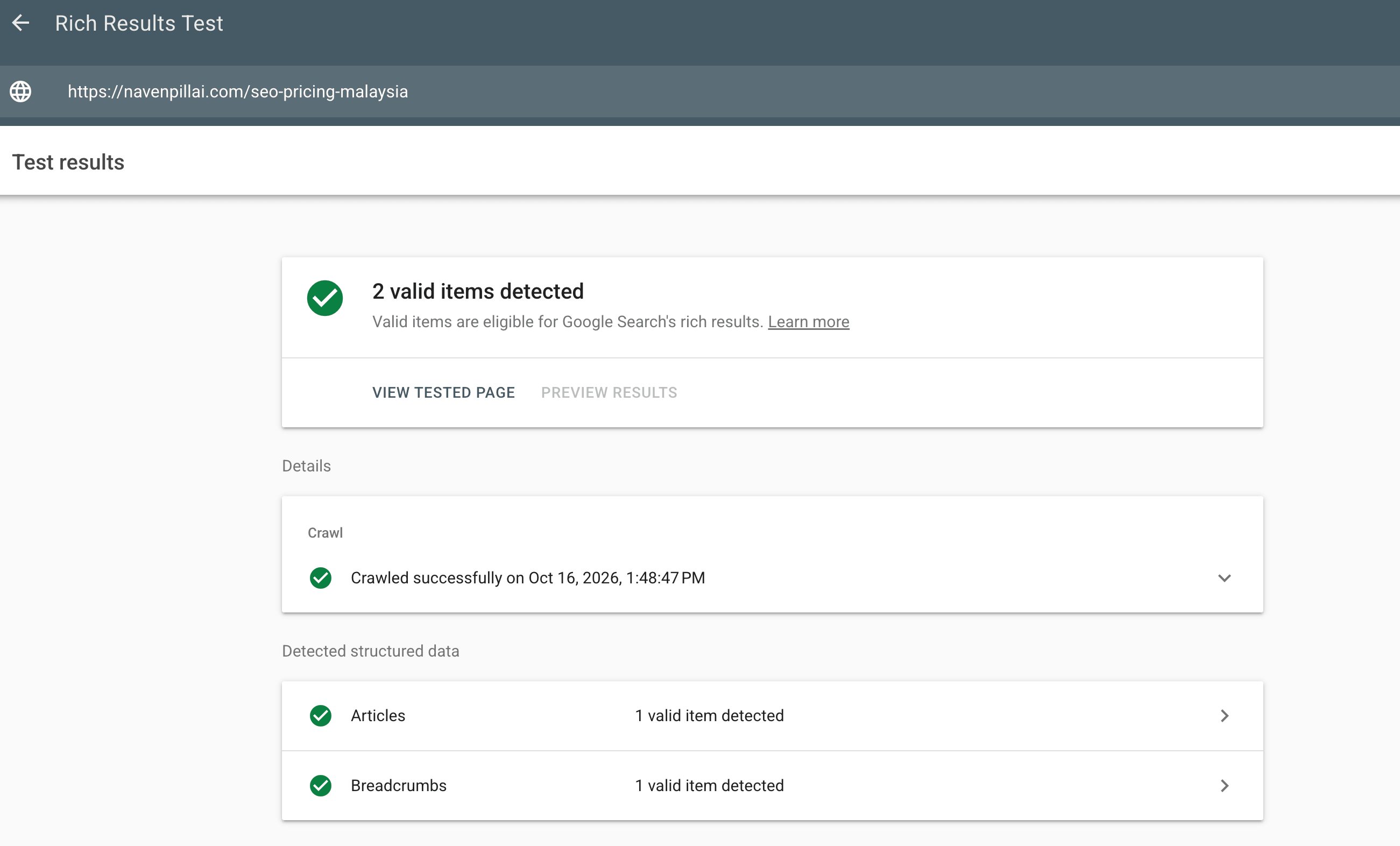
You can check out the no-code steps on the SEO checklist. For GEO, make sure the business information is complete, and the FAQ block is on. Verify it with Google's Rich Results Test.
15. Keep on topic per page, with clear headings
- Audit your website and make sure your important pages focus on only one topic. On a page that covers about us, services, and pricing at once, AI tools don't know what to prioritize.
- Use clear headings for each section within a page. Even when you look at this blog post, you can easily skim through the content by the headings alone. It's not only for the AI answer tools but also for people reading your content.
16. Show an updated date on key pages
The freshness of your pages is important not only for SEO but also for GEO. As the facts, pricing, and even features of products and services change, you need to make sure they are up to date.
- Add a visible "Updated:[Month, Year] line for key pages that have constant changes. Pricing, Services, and FAQs are some of them. If you're focused on content marketing and publishing aggressively, you may want to conduct routine fact checks on your blog posts and make the necessary updates. This can be quarterly, bi-yearly, or even yearly.
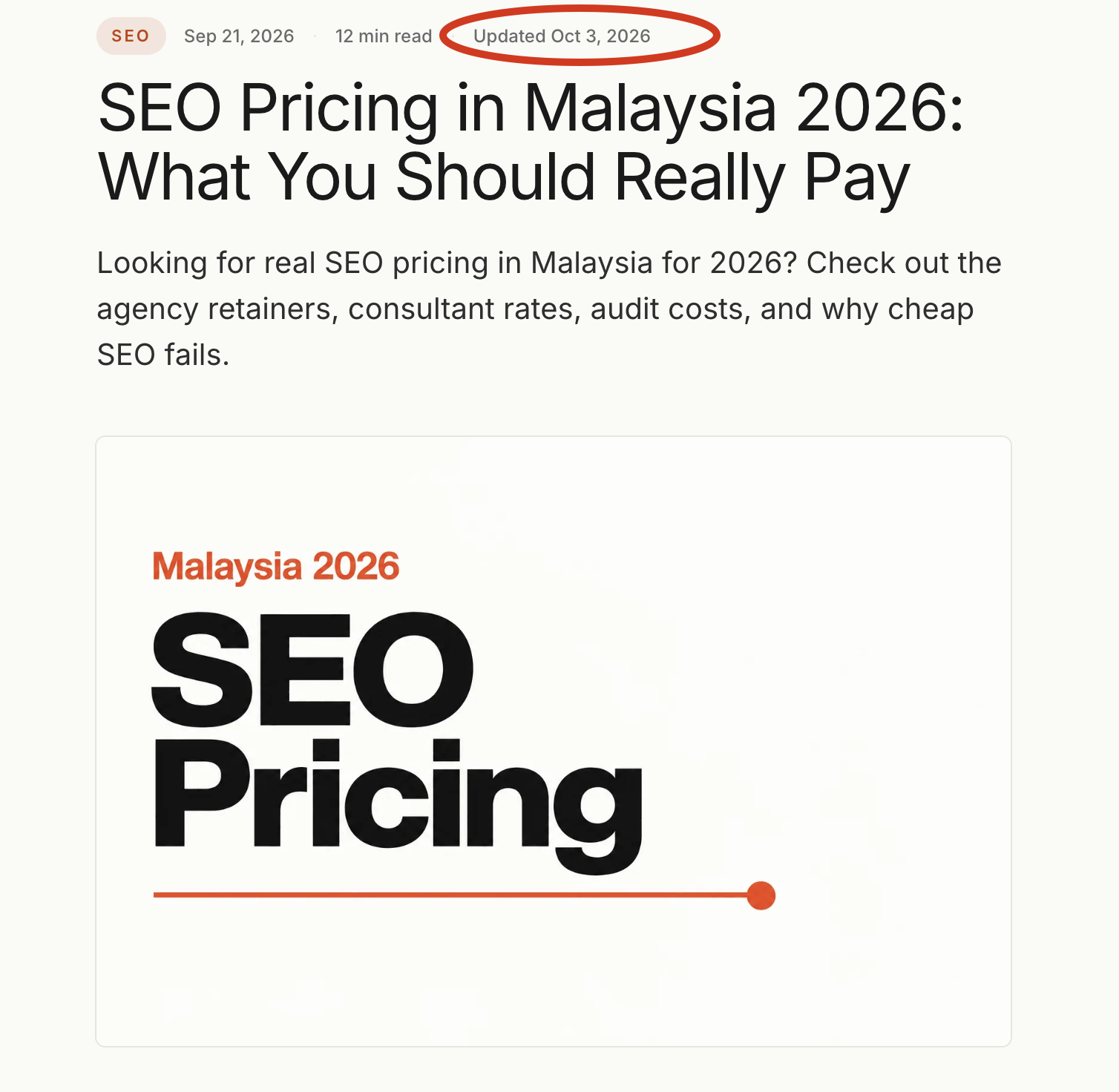
- For example, when you check some of my posts, you can see that the dates are updated at the top.
GEO Checklist 17-21 (What AI reads about you)
This part will cover the uncomfortable findings through reputation monitoring. The vast majority of AI answers rely on what others have published about you. Think about it as the GEO version of link building. It includes press releases, directory listings, and reviews.
According to Signal AI, which cited industry data, 80% to 90% of Large Language Models (LLMs)' responses rely on earned media such as news articles, third-party publications, analyst coverage, and other mentions on high-authority sites.
Just as backlinks matter to SEO for ranking higher in search results, GEO needs earned media to be mentioned and cited in response to questions about Generative AI tools.
17. Consolidate the sources AI already cites
- Do you remember that I asked you to create a document listing the websites the AI cites when answering category questions about your products and services? Open it up.
- For every cited directory listing sites where you're not showing up, create or claim your complete profile with details that exactly match those in checklist 7.
- This is the highest-leverage move to increase the likelihood of your brand being cited for relevant questions.
18. Grow and answer your reviews honestly
- If you don't have reviews, ask for reviews from your existing customers at the moment of thanks.
- Answer every review, whether it's good or bad. Don't be emotional if there are bad reviews. Reply to them politely and be open to solving the issues they are facing. Your replies are also part of the evaluation process of AI answer tools.
- Get reviews beyond Google Business Profile. Consider looking at industry-focused platforms and Facebook recommendations.
19. Earn at least one third-party mention a month
- Focus on just one mention. Ask your suppliers or vendors (if you have one) whether they can mention you or list you on their testimonial or case study pages. You can also get your business listed in association directories if you haven't already. Local news sites and your customers' company blogs are worth checking too.
- Provide complete information. Don't give half-baked information. Provide high-quality case studies, testimonials, and a description of your business (match it with step 21)
- Consistency is the key. Twelve months of effort in getting twelve third-party mentions is not something your Malaysian competitors will touch.
20. Publish one experience post each month
- Write one post that matters to your potential customers. I'm not talking about a generic 500-800 words thats flooding your niche. Focus on offering personalized advice that will gauge their interest in your solution.
- The content is one that AI tools can't find elsewhere. Experience content that addresses your customers' pain points and how you are solving them. Avoid talking about features, and focus completely on your customers.
21. Keep your business description identical everywhere
- Write a two-sentence description about your brand/business. What do you do, where, since when, and for whom?
- Use the same description everywhere. Your site's footer, Google Business Profile, social handles like Facebook, X, Linkedin, and every directory you're listed.
- When AI machines read the same description everywhere, they will include it in their answers. You are literally writing the answer that you want the AI answers to show.
GEO Checklist 22-25 (Measure and repeat)
22: Re-run AI check quarterly
- Every three months is optimum. Repeat step 3 every quarter with the same questions, and log the answers next to the previous quarter's.
- Watch for the movement. How are the mentions changing? Are the descriptions of the AI answers taking snippets from your web pages? Is your site appearing as a cited source? These are some of the movements you should track. Please expect to see changes in months and not weeks. AI answers get updated as their AI bots re-crawl and update, and there's no control mechanism over it, unlike Google spiders.
23. Track the cited source list
- Each quarter, track which sources the AI tools cite for your category or industry. There will be changes to the sources.
- Are there any new directories appearing in the answers? Submit your business. Is your competitor's blog post getting cited? That tells you what content is working. Reverse engineer and publish better content on your site while following step 17. Rinse and repeat forever.
24. Watch your brand searches
- In Google Search Console, filter Performance to queries containing your business name (brand). See whether they are increasing or reducing. Check which pages are ranking and cross-check them with Generative AI tools.
- Rising branded searches influenced by AI mentions. As the AI answer market is still new, there are not many studies to support this claim. Let's look at it from an audience perspective. When people see a brand name in AI answers, they will search the brand on Google to know more. That's a branded search. An imperfect signal, but it's free and directional.
25. Invest in a monitoring tool when the basics are done
Manual checks are the honest baseline.
Always remember that tools help you save time on repetitive tasks so you can focus on the work that brings in more money for your business.
Once you've completed steps 1-21 and AI visibility is a metric you report on monthly, the right tool will help you automate manual tasks and start monitoring changes.
I've reviewed Otterly.ai, which starts around RM125 per month. You can also evaluate other tools, but compare the results against your baseline.
You don't want to see huge differences in results.
Avoid purchasing any AI answer monitoring tools before doing the work.
My honest take
Everything I've listed above is free except for your time.
In Malaysia, the opportunities are widely open. Most of your competitors haven't undergone a systematic review of their AI answers.
The Malaysian market is still growing, and you can dominate the GEO platform with this checklist.
I'm aware that you are unable to perform the harder layers. You need someone who can get it done for you. If you're hiring an agency or a freelancer, you may want to check my blog post on SEO pricing, which also covers GEO.
You can't optimize your site specifically for Generative AI tools, as GEO and SEO follow the same practice.
Lastly, I would like to remind you that no one can guarantee you a spot in ChatGPT answers. You can only increase the odds of getting mentioned by following this GEO checklist.
If you have any questions, please feel free to get in touch with me.
GEO Checklist for Businesses in Malaysia 25 Steps (2026)Download→