Register Control: A 30-Minute Table for BM Formality
Map every audience-platform pair to a defined register; Bahasa Baku to Manglish — so AI drafts hit the right formality every time. Build once, reuse forever.
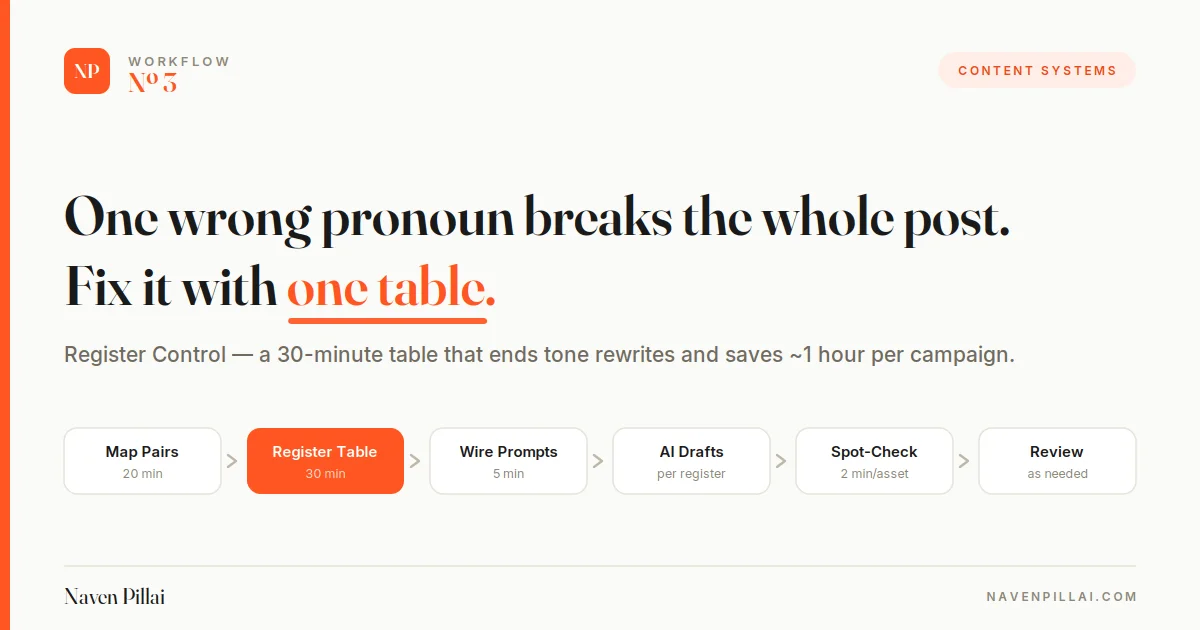
Building a one-page register table that maps each audience-platform pair to a defined level of formality.
Some platforms may require full Bahasa Baku, while you may want to use Manglish on Facebook or TikTok.
Attaching this workflow to every drafting prompt will help you craft a content style for the same message, tailored to the content platform.
A 30-minute effort to build the workflow that can be reused forever.
Without this workflow, you may end up creating a draft that needs major edits. And you don't want your content to sound like a ministry circular on social media, or writing "korang" to a procurement officer.
Why does this workflow matter?
The formality range in Malaysian marketing is wider than in other regional markets. The same SME might post a TikTok caption, reply to a customer in Manglish, and submit a government tender proposal.
You can see that I'm continuously writing about register.
So what does this register actually mean?
When you see the term "register" with prompts and AI, it refers to linguistic register (the level of formality). It's about how the generated content should sound.
For example, let's say you want to write an email to your customer explaining the delay in support. You can ask the generative AI tool to use a formal register in crafting the email reply.
Going back to the registers.
English has well-defined registers, but in Bahasa Melayu, register is signaled sharply by pronoun choice alone("anda" vs "awak" vs "korang"). Using the wrong pronoun doesn't read as a typo; it suggests you don't know your audience.
As a marketer, you don't want to cause significant damage to your brand identity by using the wrong messaging style with the wrong audience.
LLMs handle registers well when you provide the right instructions. You don't want your drafts generated and your brand messaging distributed with the default setting.
The multilingual pipeline usually carries per-asset register lines. And this workflow is the best example of a documented map of deciding on which voice goes where.
So the registers do not require you to perform them repeatedly for every campaign.
The Workflow
Map your real audiences × platforms (20 min, once)
→ Write the register table with example lines (30 min, once)
→ Attach to every drafting prompt alongside the voice doc
→ AI drafts at the specified register per asset
→ Spot-check: pronouns, particles, sentence length (2 min/asset)
→ Review when a new audience or platform appears
Take note: the generative AI executes the registers; it never chooses them. Every prompt will name registers from the table you've generated.
Step 1: Map the combinations you use (20 minutes)
List every audience-content platform that your content touches. Most SMEs have five to seven platforms:
- Consumers on TikTok/IG
- Consumers on FB
- Leads on WhatsApp
- Corporate buyers via email/LinkedIn
- Government or GLC audiences via formal documents
- Press via releases
A register you defined for an audience you don't engage with can be clutter.
And the best part of register tables' power is that they're short and straight to the point, to be obeyed.
Step 2: Write the register table (30 minutes)
Add this to each row of the table: the audience, the register name, the mechanical rules, and most importantly, one example line, the same message rendered at that register.
== REGISTER TABLE — [BRAND], v1 ==
Message used in all examples: "our promo ends Friday"
R1 FORMAL BM (gov/GLC/corporate docs)
"anda" · full bahasa baku · zero loanwords where a BM term
exists · no contractions, no emoji
→ "Promosi ini akan berakhir pada hari Jumaat ini."R2 SEMI-FORMAL (email, WhatsApp to leads, landing pages)
"anda" · natural sentence flow · English product terms fine ·
warm but not chummy
→ "Promosi kami berakhir Jumaat ini — sempat lagi kalau nak."R3 CASUAL SOCIAL (FB/IG)
"anda/awak" flexible · light rojak where natural · particles
ok ("kan", "je") · max one emoji
→ "Promo tinggal sampai Jumaat je! Jangan tunggu lama-lama."R4 FULL COLLOQUIAL (TikTok, memes)
"korang" · rojak freely · reads like a creator, not a brand
→ "Korang, Jumaat ni last day promo. Serious tak tipu."EN equivalents: R1 formal-professional → R4 punchy-casual,
same ladder, same rows.HARD LINES:
- Anything entering a tender, proposal, or official letter: R1
only, no exceptions, regardless of how "friendly" the contact is.
- Complaint responses: never above R2 casualness. A breezy reply
to an angry customer reads as mockery.
- Religious or festive greeting content: R1–R2 only.
The HARD LINES section is where you encode your judgment.
Discuss with your team and argue about these once for documentation purposes. Please don't do it for every campaign review.
Step 3: Wire it into the prompts (5 minutes if your pipeline already exists)
If you're running a multilingual pipeline, the instruction in the adaptation prompt for the asset register will reference table rows instead of ad hoc descriptions.
For example, "Asset 4: R4 as per the register table" refers to the master brief pipeline. This results in shorter prompts, zero drift between campaigns, and a new team member being able to inherit the whole system by reading one page.
Step 4: The spot-check (2 minutes per asset)
You don't need to check the whole piece. If there's something wrong with the level of formality, the mistakes are easy to discover and fix.
So, check them and move on:
- Pronouns: A single casual word like "korang" in a formal (R2) email instantly breaks the tone.
- Particles and slang: It comes down to density where R3 uses slang lightly, like a seasoning in a dish. R4 is drenched in it.
- Sentence length: R1 writes in long, complete sentences. R4 writes in short fragments. A piece can use all the right words but still feel wrong if the rhythm and structure don't match.
If something fails the check, don't prompt with vague feedback like "the tone feels off".
Point out the specific rule: "This reads as R3, but the brief said R2". Please keep it to the point.
The Math
Setting up this workflow takes 30 minutes, and that's just once.
The payoff comes in two forms:
The small payoff: less editing. Fixing the formality level is one of the most common corrections humans make to AI drafts. A prompt built on your register table removes most of those fixes, saving you close to an hour per campaign.
The big payoff: avoiding the disaster scenario. The real risk is the embarrassing mismatch that someone finds, screenshots, and shares. A brand using rough street Malay in a formal context, or stiff government-style Malay when talking to teenagers, can be harmful for the brand's reputation.
That mistake becomes joke material on other people's social feeds. And because this negative impact never appears in your analytics dashboard, teams often overlook it and fail to prevent it.
Where this workflow breaks
There are four common ways teams get this wrong:
- Letting the generative AI tool guess the register. This is the exact failure the whole workflow exists to prevent. When the AI guesses, you will get bland, inconsistent language that offends nobody but also connects with nobody.
- Over-complicating the table. Adding rows for audiences you don't actually have will turn your simple table into a final year thesis.
- Forcing casual slang everywhere as "brand personality". For most brands, the language's slang looks like borrowed clothing. The audience can tell right away that it doesn't fit you.
- Treating the table as done forever. Language moves. The casual English-Malay mix that sounded natural last year can come off as try-hard this year. If your spot checks keep flagging the same row, please update them.
You don't have to complicate the register table. If you sense something is wrong, always recheck the key parts of the workflow and update them as needed.
Register Control A 30-Minute Table for BM FormalityDownload→