The 2-Hour Brand Voice Document: A One Page AI Workflow
The setup workflow every AI content system depends on: extract your brand voice, test it, attach it to every prompt. One page, two hours, built once.
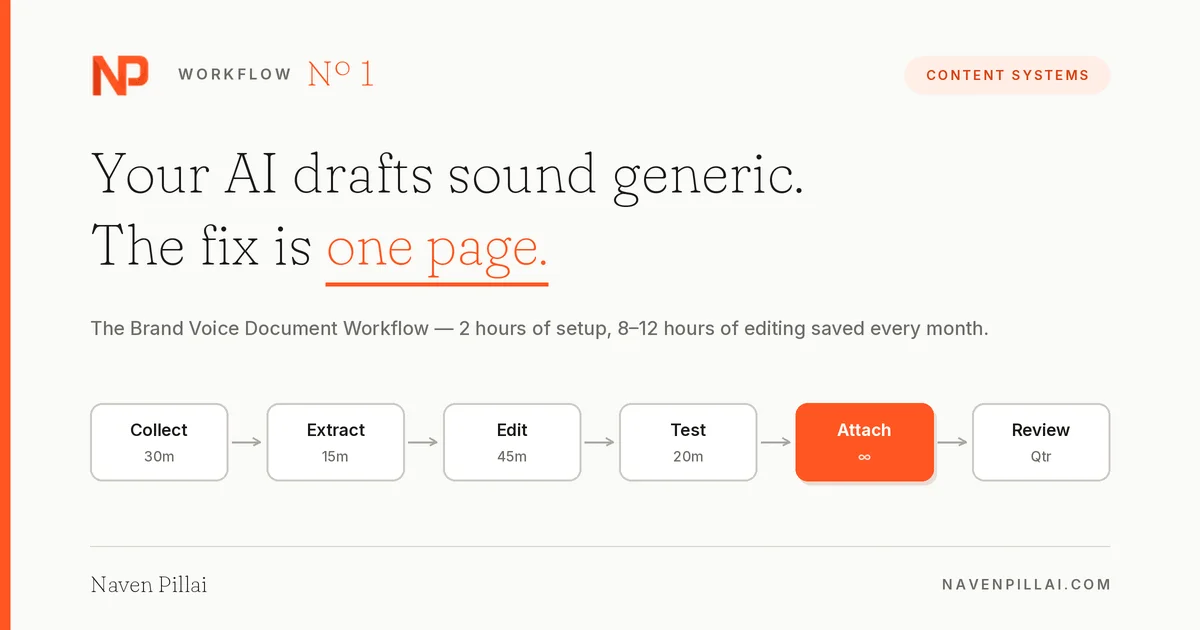
Create a one-page document that defines your brand voice. You want to make sure your brand voice is unique and not overshadowed by a generic AI voice. Remove the unwanted AI words and register important notes in every language.
You can use this brand voice document for every AI drafting session. This single document will make a huge difference between the AI drafts that you edit in five minutes and AI drafts you rewrite from scratch.
Why this workflow matters
If you ask any Malaysian marketers why they have stopped relying on AI for copywriting, you will hear similar replies: "the output sounds too generic."
The diagnosis is correct, but they reached the wrong conclusion.
The model did not fail. You did not provide what your brand sounds like, so it came across as average generic marketing copy.
Only definition.
There's no unique blend to the brand voice.
The teams that get unique drafts aren't prompting harder. They're attaching the same one-page brand voice document every time a draft is created.
The model stops guessing and starts matching. That's the entire workflow you should be aware of. And almost nobody in Malaysia has done the two hours of work that will have a greater impact in the long term.
The Workflow
Collect your 3 best past pieces + 2 worst (30 min)
→ AI extracts the patterns into a draft voice doc (15 min)
→ Human edits it down to one page of enforceable rules (45 min)
→ Blind test: draft with and without the doc (20 min)
→ Attach to every drafting prompt, forever
→ Review quarterly (15 min)
Step 1: Collect the evidence (30 minutes)
Five pieces that represent your brand's unique voice.
- a post that got real engagement
- an email customers replied to
- a page that converted
And also include two pieces of information that were off - too stiff, too hype, and completely outsourced. The worst pieces matter as much as the best. It will indicate "we're not this," and it's easier to enforce than "we're this."
If you're a new brand with no past pieces, you can leverage your competitors: three to five whose voice you'd want to emphasize, two to three voices you'd avoid.
Please revisit the workflow and replace them with your own materials within the next six months.
Step 2: Let AI do the pattern extraction (15 minutes)
Below are 5 pieces that represent our brand voice at its best, and 2 that got it wrong.
Analyse them and produce a draft brand voice document with exactly these sections:
WHO WE SOUND LIKE: one sentence. A recognisable persona, not a list of adjectives. ("A senior consultant explaining things to a smart friend" — not "professional yet approachable".)
WE ALWAYS: the 3 strongest patterns in the good pieces, stated as rules a writer could follow.
WE NEVER: every word, phrase, and habit that appears in the bad pieces but not the good ones. Include punctuation and emoji habits.
SENTENCE MECHANICS: typical sentence length, paragraph length, how the good pieces open. Be specific enough that a stranger could imitate the good pieces using only your rules.
The AI's draft will be 70% right and 30% flattery.
The next step will help you fix that.
Step 3: Edit to one enforceable page (45 minutes)
This is the human step, where the document solidifies and maintains the quality of this workflow and your brand voice.
Remove every rule that's aspiration rather than description.
For example, if the document says "confident and bold" but your best pieces are careful and evidence-led, it's describing the brand you wish you were. And every AI draft will sound like a stranger.
Make sure to describe your voice thoroughly
To do that, you need to add sections the AI doesn't know:
== BRAND VOICE — [BRAND], v1, [DATE] ==
- WHO WE SOUND LIKE:(one sentence)
- WE ALWAYS:(3 rules)
- WE NEVER: (banned words and habits, make sure to provide as much details possible)
LANGUAGE NOTES:
- EN: (mechanics from step 2)
- BM: (default pronoun per register; rojak policy; which terms stay in English)
- ZH if you run the Chinese layer: point to that addendum]
- 3 EXAMPLES OF US AT OUR BEST: (paste them in full)
- 2 EXAMPLES OF WHAT WE'RE NOT: (one line each on why)
Your banned list requires real attention. Every Malaysian brand should probably use the English LinkedIn often defaults to. Make sure to have specific entries. I often ban terms like "game-changer", "naturally", "practically" and "seamlessly" among others.
You might want to ban exclamation marks, or "dear", or the word "solutions". Always remember to be as specific as possible to make the list enforceable.
Step 4: The blind test (20 minutes)
The same brief with two drafts.
One with the voice document attached, one without.
Show both results to someone who knows your brand but did not build the document. If they can pick which draft sounds like "us", the document rules are too easy.
Sharpen the "never" list and the persona sentence first; those two sections carry the most weight and determine your unique brand voice.
Update the examples, remove dead rules, and add new relevant banned words, especially the one with AI-slop. AI can come up with a lot of unwanted words, and you want to give your complete attention.
The Timeline
Without voice document:
- Edit time per AI-drafted asset - 20-40 minutes (often full-rewrite)
- Output consistency across writers - Whoever wrote it
- Setup: Not available
With voice document:
- Edit time per AI-drafted asset - 5-10 minutes
- Output consistency across writers - Structural
- Setup: 2 hours (only once)
This workflow will help you save 8-12 hours of editing time each month. You don't have to rewrite your drafts from scratch anymore.
The most valuable part of the document will be the output consistency. Even when your best writer resigns, the brand keeps sounding like your brand. A two-hour brand voice document acts like an insurance against your writer's resignation.
Where this workflow breaks
The Aspiration rules: the most common failure, and the reason behind step 3.
Writing it once and not testing it will make it read like an unverified voice document, similar to a horoscope. It may also look vague enough to be a perfect match.
Building the voice document is no problem, but failing to attach it when creating your drafts will be. Make sure to check your team's actual AI prompts every month.
If the brand voice document is not attached, the workflow has silently failed at the last voyage.